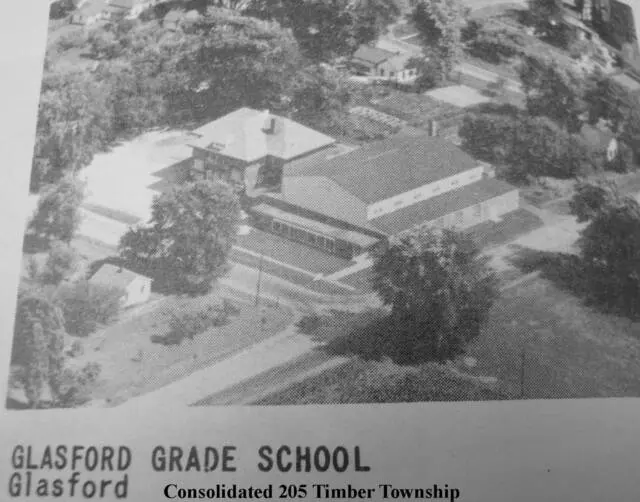
Timber Township School Consolidation 1945
- Glasford School, District #129: 1959 #319; 1969 part #324 Farmington, part #327
- Saylor School, District #130: 1959 #319 Westwood CC; 1969 part #324, part #327
- Todd School, District #131: 1959 #319; 1969 part #324, part #327
- Griggs School, District #132: 1953 #149 Oak Grove; 1960 #320 Lancaster-West CC; 1969 part #324, part #327
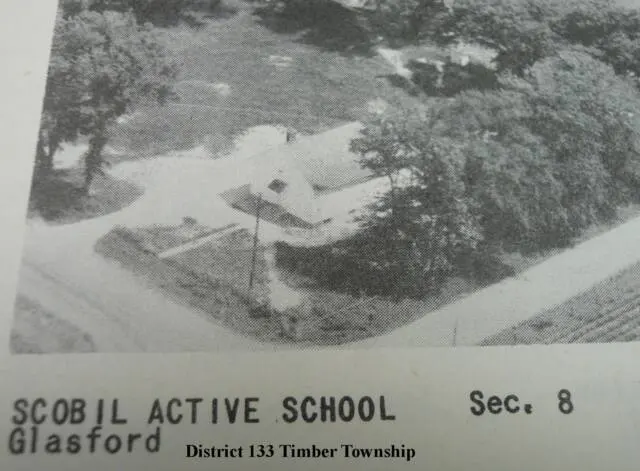
- Scovil School, District #133: July 1, 1963 con. with #149 and Fulton Co. to form #320; 1969 part #324, part #327
- Cowser School, District #134: 1921 #205 Consol Glasford; 1929 Withdrawn from #201; 1969 #327
- Bateman School, District #135: 1921 #201; 1955 Withdrawn from #201; 1969 #327
- Centennial School, District #136: 1921 part #205; 1921 part #317 Mapleton CC
- Kingston Mines, District #137: 1921 #205; 1969 #327
- Tyndall School, District #138: 1951 #133 Fulton Co.; 1963 #320; 1969 part #324, part #327
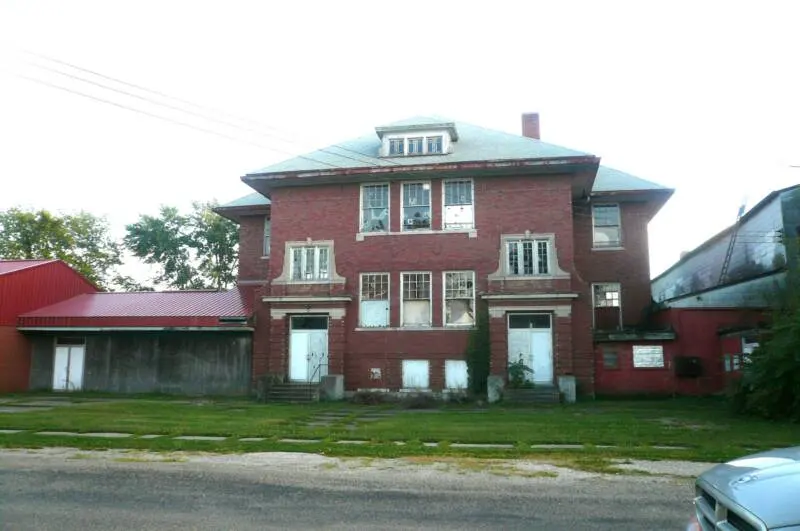
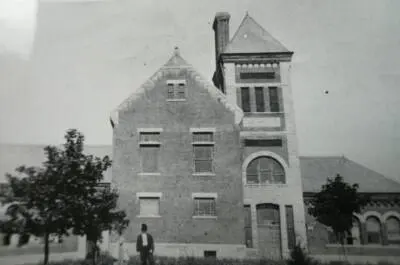
Former Glasford Grade School and Gym, September 2009. A sad ending for a building that saw thousands of children pass through its doors.
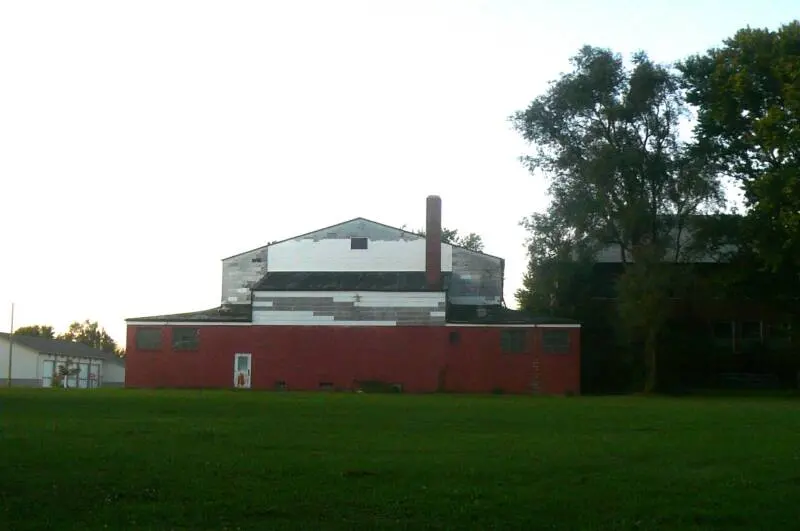
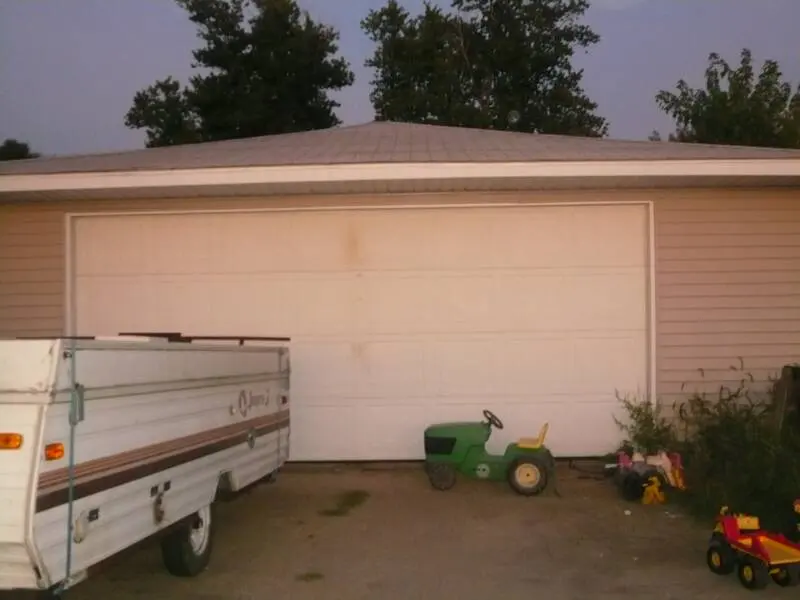
Back of gym that was moved to Glasford in 1948 from Camp Ellis near Ellisville, Illinois. The gym was dismantled and rebuilt on this site next to the school.
Glasford School, District #129
From the Glasford Gazette, Sep 1949
The first school house in this vicinity, with the exception of one at Lancaster, was built in 1830, on the land now owned by Ralph Jefford, east of Glasford. It was made of logs, of course, 16 x 24 feet, with a big fireplace in one end. The floor, seats and teacher's desk were made from logs split in halves. Above the teacher's desk one log was cut away and the hole covered with greased paper, making the only window.
Later there was a school built at Tichnor's Crossing, on the T. P. & W. Ry., north of the present Gus Olson farm.
There was also the Baty School at the Hootman's Corners, the four-corners north of Glasford on the present Lancaster street, and the Duffield School, west of the present Karstetter farm home, north of Glasford, on a road running east and west on the north side of the brick house which formerly stood there.
The first school house in Glasford was built in 1875. It was a one-room school, and later another room was added on the rear.
By 1902 the school had become so crowded it was necessary to build a small one-room building on the northeast corner of the school grounds. The primary room had occupied the class room of the M. E. church the year previous.
In 1903 an election was called to vote on building a new school house, but the proposition was defeated.
In 1904 a bond issue of $4,500 was carried by a majority of ten votes. It was first planned to build a brick building but it was found that it would cost more than the bond issue would allow.
The old school building was bought by James Petty and John Friess, cut in two and moved up to Main street for store buildings. One half is now occupied by the Hinderliter apartments, and the other, on the corner now occupied by the Fahnestock Motor Co., was torn down.
In 1905 a 4-room, 2-story frame building was erected. It was a modern building for the times, containing basement, heating plant, cloak rooms, library, etc., costing $6,000, completed. Walter Eagles was the contractor.
On November 28, 1912, when only seven years old, the school building was destroyed by fire.
Immediately agitation was started for a brick building, and January 28, 1913, by a vote of 77 to 6, the district decided to build a $12,500 brick school house. It cost more than that, and a number of citizens guaranteed the payment for finishing the building.
The present building has four commodious school rooms, two class rooms, principal's office, library, cloak rooms, with full basement and steam heating plant. Many other improvements have been added, including toilets in the basement.
In 1922, districts 129, 134, 135, 136, and 137 formed consolidated School District Number 205. A large four-room brick building was erected, fully equipped and modern in every respect. The schoolyard is large and well located to serve the pupils. The building has a large furnace, which makes the building sufficiently warm at all times. The school has three teachers and is considered very successful as far as the school is concerned. The one big drawback of the consolidated schools in Illinois is the transportation problem and this had its effect at #205. Two of the districts have withdrawn, #134 and #135, because of this situation.
At a special election held in 1922 the patrons of Glasford, Kingston Mines, Centennial, Cowser and Bateman School Districts voted, by a majority of 191, to consolidate. This district is now known as Community Consolidated District No. 205. Cowser and Bateman districts later withdrew but Cowser is again a member of the consolidated district.
At another special election held August 28, 1923, a bond issue of $7,000 for building a new school house at Kingston Mines was approved. The same night the old school house was mysteriously burned.
The present officers of District 205 are: President, Clyde Dorethy; secretary, John Kaufman; members, Lloyd Gouff, Arthur Bonk, John Kingsley, Albert Probyn and John Goetze.
The present faculty of Consolidated School Dist. No. 205 is: Principal Virgil Stanton, Buell McKee, Dorothy Walley, Madge Carlson, John Comerouski, music, Gladys Stanton, special teacher; total enrollment 124. Kingston Mines: Grace Baker, Idabelle Wright; enrollment 61.
Sept 1949
Saylor School, District #130
N.W. ¼ of the S.W. ¼ Sec. Timber Township 7 N. R. 6 E.
1849-1858 Ebenezer Pinkerton
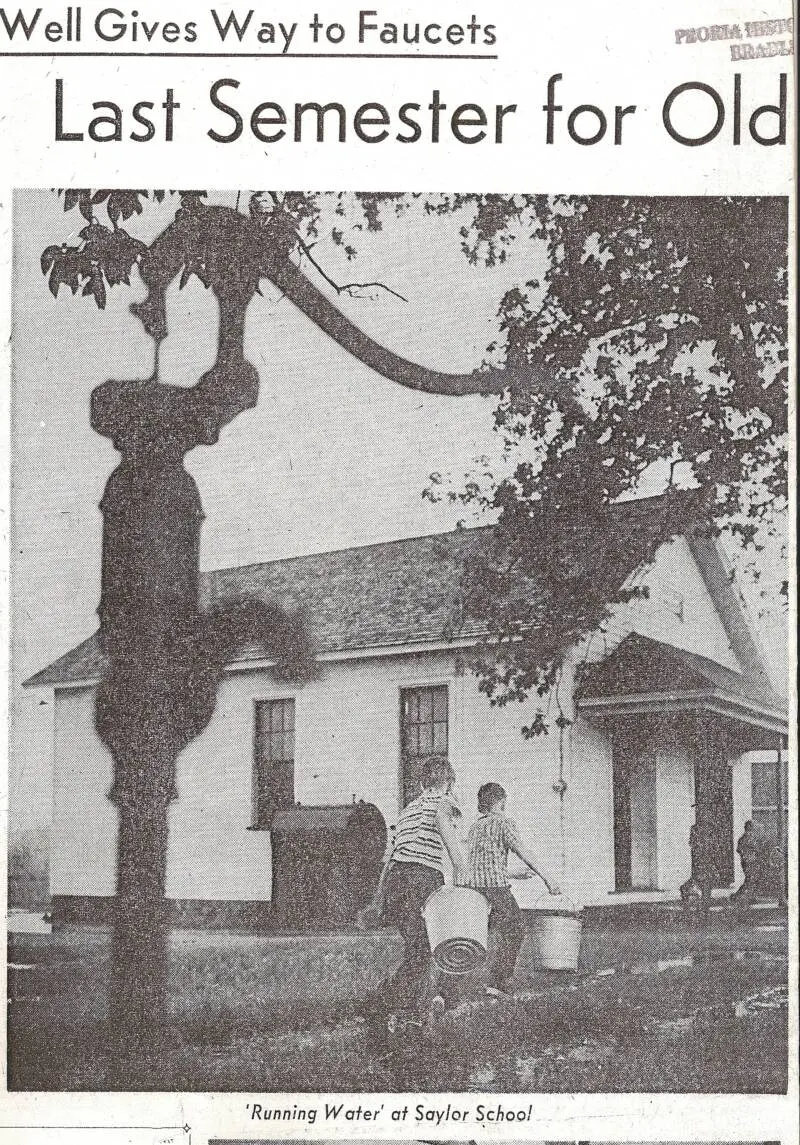
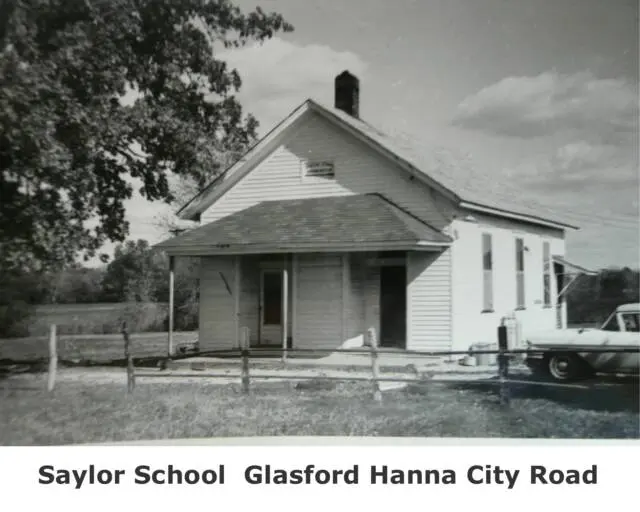
Peoria Historical Society Collection, Bradley University Library. Peoria Journal Star, Fri. May 27, 1960. By Jean Kenyon, Journal Star Staff Writer.
Pupils at the one-room Saylor School south of Hanna City made their last trip to the well yesterday. Next September classes move to a new four room building with “modern conveniences.”
“The only running water we have here is when the children run out to the well and get it,” says their teacher Mrs. Frances Brewer.
A landmark in the area since at least the 1880’s the little one-room school where Bobby Janssen, 11, finished his last day of sixth grade yesterday, still looks much the same as it did when his grandfather, R. T. Janssen, 86, attended the school.
Bobby’s grandmother, Mrs. Martha Neuerman, and his William Janssen both are Saylor graduates, too.
On the wall still waiting to be packed yesterday were the dark old German prints and a reproduction of Gilbert Stuart’s portrait of George Washington that must have been put up when the school opened.
In the corner still stands the wooden washstand with its washbowl and dipper for ladling water. The vestibule has coat hooks.
For all the “primitive plumbing” and lack of hot and cold running water, both Mrs. Brewer and her pupils expect to miss their one-room school.
“I love it out here,” Mrs. Brewer told a reporter, “there are no discipline problems, and I don’t want to be a policeman, I want to be a teacher.”
Whether the quiet of the country or the sense of responsibility developed early in a one-room school is to be given credit, the question of discipline hasn’t arisen.
“I feel I could go to town and back, and nothing would go wrong in my absence” is how Mrs. Brewer feels about her pupils.
When she first began teaching at Saylor three years ago she taught the upper four grades. Since last year when Saylor, Harker’s Corner and Todd Schools consolidated she has taught fourth, fifth, and sixth grades. Until 1957 all eight grades were taught in the single room. Just down the road a quarter of a mile is being constructed the new brick $70,000 Westwood Community Consolidated School where 80 pupils of the three schools will be collected under one roof next fall for the first time.
District #319 will have a principal, Laurence W. Geltmaker, who will also teach seventh and eighth grades: Mrs. Emilie K. Clinbell teaching first, second and third, and Mrs. Brewer with the middle grades.
The new school will have three classrooms, and indoor toilet, as well as an all purpose room to be used for a gymnasium and a kitchen for parent-teacher events.
What it won’t have will be the sense of intimacy and dependence upon one another, which is part of the one-room school.
Sometimes the togetherness is a little pressing. Mrs. Brewer has learned that on days when she would like a few minutes to herself there is no place to retreat to in a one-room school.
Even so she regrets leaving it, “here the children always seemed to be aware that they had come for one purpose, to learn, while in larger schools, they somehow seem to think they’ve come to have fun.”
The Saylor School which has schooled some 2,400 pupils in its one room will go on the auction block, together with one acre of ground on which it stands, sometime this summer.
Former Todd School moved from where school stood in 1945, but still located on Todd School Rd. 2001
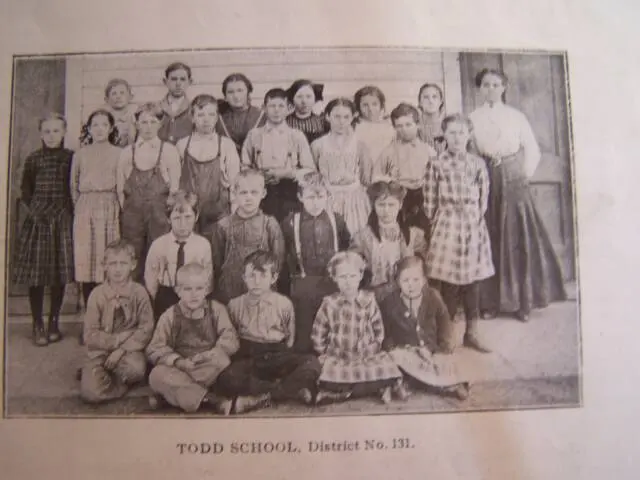
Todd School, District #131
The Todd School, District #131, Timber Township, Peoria County, was organized early. It had the first school building in Timber Township and was about seventh in the county. The school building was erected about 1835 or 1840. This first school was very typical of the old school buildings, with log benches around the outside of the wall and one or two split log benches, hung higher and used to write on. In the center of the room stood an old stove, which scorched those near it and let those around the outside walls freeze.
This old building stood about thirty rods north of where the new building is located and which was erected about 1875. This building is standing at the present time with a few alterations, additions and improvements.
The school is equipped with a large sanitary heating and ventilating system which stands in the northwest corner of the room and takes the place of the old stove which stood in the center of the floor. A library, dictionary, and modern seats complete the existing equipment.
John Hayes
On Todd School Rd. between Hanna City/Glasford Blacktop and S. Trivoli Rd. (past S. Martin Rd.)
Griggs School, District #132
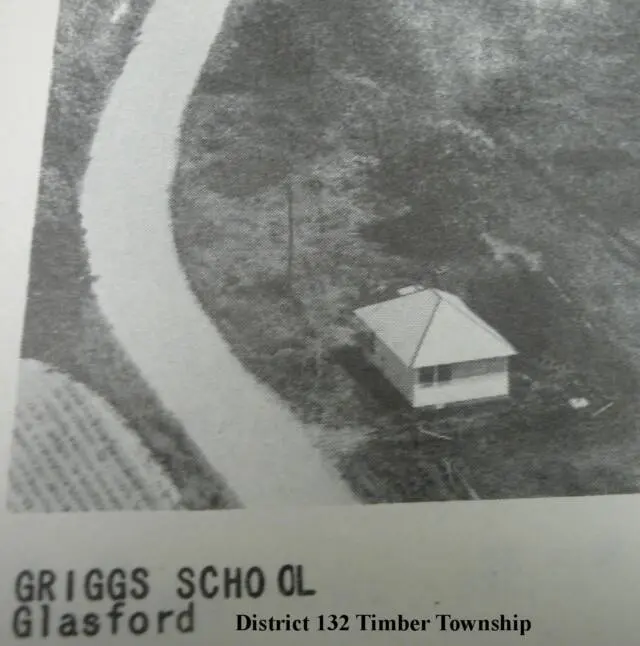
The Griggs School is one of the old districts of Peoria County. It had its first school about 1840 and not later than 1844. The district at one time was much larger than it is now, taking in parts of Scovil and Todd Districts. The first building was probably built of logs, but as no one is alive today, and as there was no record kept of it, there is no way of determining, however since all the school buildings of the county, with the exception of those built in Peoria, and one other which was near a saw mill, built at that date were log structures, we feel safe in saying it was of this type. The next building erected was built in 1863, a small frame structure, almost as out of date and unsatisfactory as was the log cabin.
In 1917, when the sanitation law came into effect, that with many other school regulations, which were impossible to conform with having the building of 1863, the district erected a new modern building. It is a modern structure in every respect, comfortably taking care of thirty pupils, should such a group enroll, however the enrollment so far has not exceeded twenty.
John Hayes
S. Trivoli Rd. past Todd School Rd. and Phillip Rd.
Scovil School, District #133
Scovil School District #133, is composed of two districts of earlier times, the Lee District which had its first building in 1868 and the Lancaster District which had its first building 1850.
The first building in the Lancaster District was a frame structure, cut and put up by John Willie. The building was quite ideal for its time, having windows on two sides, a large stove in the center, and a school master who taught his pupils to the tune of a willow stick. It is known that previous to this building, a log cabin was used for a school for about eight years, the history of this school, its structure, and teachers, has been destroyed, if any was ever kept, but at that time, it would be safe to say, the school was run on the subscription plan with the teacher boarding around. The school in those days was not only used for a school but for every gathering the community might have. In 1860, the people gathered to vote for Lincoln.
The building was enlarged to accommodate the growing number of pupils in the year 1859, this being the last major change until the joining with Lee in 1868 and stood as erected until service was discontinued in 1888. The school was small and district small. Probably this was one of the reasons the community was willing and anxious, for the most part, to join with Lancaster when they were building their new school. None of the pupils were required to go too great a distance, and besides this, for less money better facilities could be had and better opportunities for learning could be offered the pupils in attendance. Even these facts in mind as we see it today, many people were opposed to the combining and many hard feelings arose in the community at the time the controversy was on.
Since the building of the school in 1888, changes have been made by the district to conform with the state school regulations.
John Hayes
W. Trivoli Rd. and W. Maple Ridge Rd.
Cowser School, District #134
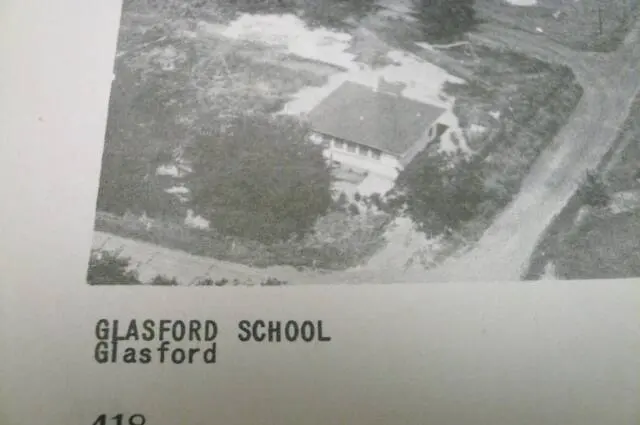
The first Cowser School was located on Hootman’s Corner, one half mile north of Glasford and was known as Baty School. This school was probably built about 1859 or 1860, the exact record is not available. This building was similar to other schools of its time. It had a large cannon stove in the center, long benches for the pupils to sit on and the teacher “boarded around”. This building was in use until 1885 when a piece of ground was purchased from George Cowser for the purpose of building a new school. The school was built this same year and has been in use ever since. The building was built with windows on one side only, an idea which was not considered at that time but has since been proven satisfactory and passed in the form of a state law so the school in one respect, at least was 35 years ahead of the other schools in Peoria County. This district became a part of the consolidated District in 1921 and was part of it until 1920, when the district voted to be separated and became a district as prior to the consolidation program. This was done and at the present time they are in progress with their second year as #134 again.
Glasford/Canton Rd. between S. Trivoli and Glasford
Bateman School, District #135
Bateman School, District #135, of Peoria County, started in a small log building on the Bateman homestead in 1867 with James Stibbins, Joe Green and R. McAvoy acting as directors. The log building, very typical of the early school, had as a heating plant, the picturesque fireplace. It had only three small windows and one door. Rude wooden benches seated about forty pupils; these benches were without backs and the front rows were smaller, to be used by the smaller children. The blackboards were only boards painted black. At nine o’clock each morning, school began with the scholars singing their multiplication tables and capitals of the states.
School continued in this building only one year; the district decided that a new building was needed and in 1868, a small frame structure was erected by Andy Green. This building was placed on the present school site and did service for fifty years. The siding was of white pine and the floor of hard maple which may account for its remaining in good condition for so long.
The teachers were hired for periods of three months at first and later for six months but in this district did not practice “boarding” around, but for many years stayed the entire term with G.M. Bateman and his wife who lived very near the school. The smallest salary recorded as having been paid at this school was $26.00 per month. Those early day lickin’ and larnin’ were considered inseparable and then spelling down predominated over all other sports. Friday afternoon a bee was held each week and very nearly every week one night was devoted to the same thing at which time everyone entered, young and old alike.
District meeting for the election of directors called forth all the voters of the district and as many as forty-three have cast votes in District #135. It was evident that much interest was taken in community affairs of those days. As time went on, however, attendance at the school and attendance at the meeting fell off. The district went under #7 until 1903 when it became #135.
In the spring 1916 the people voted for the erection of a new building. There had been some talk of changing the site and Judge J.R. Curran of Pekin generously offered an acre of ground if it were moved to one of his farms on the river bottom road. The project was not carried and the new building stands where the old one welcomed its scholars for nearly half a century. This structure is bungalow style and is heated by a Weir furnace. Since 1916 the changes, which were necessary to make the school standard, have been made and the equipment has been kept right up-to-date so that the school is among the very good schools of the county at the present time.
John Haynes
Off of Rt 29 on road to Glasford
Centennial School, District #136
Centennial School, formerly called Ticknor School and then Scott School, now a part of Consolidated District #204, previously #136 and originally #8, had its first organized school about 1860. There may have been subscription schools previous to that but no records have been kept, nor is anyone alive who lives in the district now, who can add to our information. This school was one of the old type and was used until 1876, when a special meeting to levy a tax was held and by the following fall a new school building was erected and fully equipped, for a cost of $1521.77. In 1921 this district became extinct and is now a part of the Consolidated District #203.
Kingston Mines, District #137
Kingston Mines School District #137 was started in 1840. The schoolhouse was small and greatly overcrowded so in 1860, shortly after the coal mines began to flourish in the vicinity, a two room building was erected. This building stood as it was built until 1880, when it was moved to a better site, giving the school a very good view of the Illinois River. The school was changed and modernized at different times but as the community was slowly but surely moving away after 1916, the enrollment dropped off considerably and in 1921 when this school became a part of the Consolidated District #205 (Glasford), the enrollment was less than half what it had been in earlier times.
The building continued to be used as a part of #204 until the new Illini Bluffs School was built. Kingston Mines School was torn down.
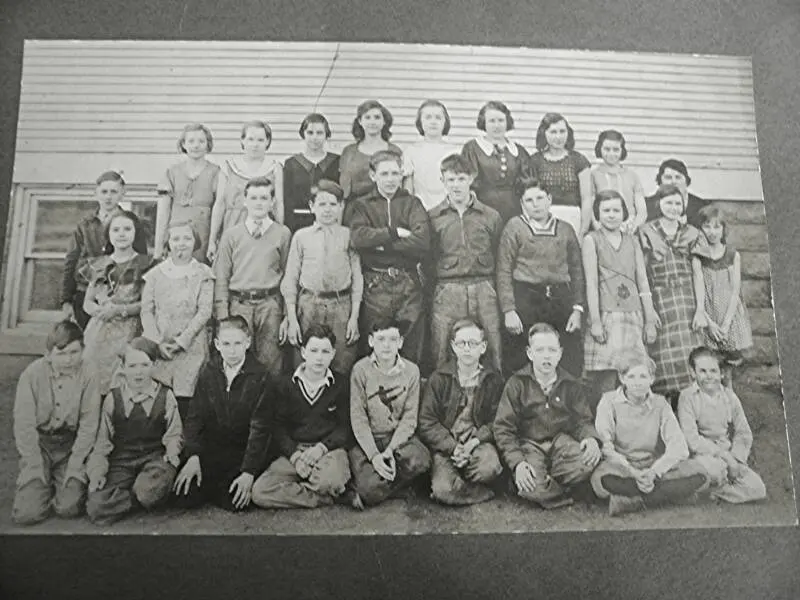
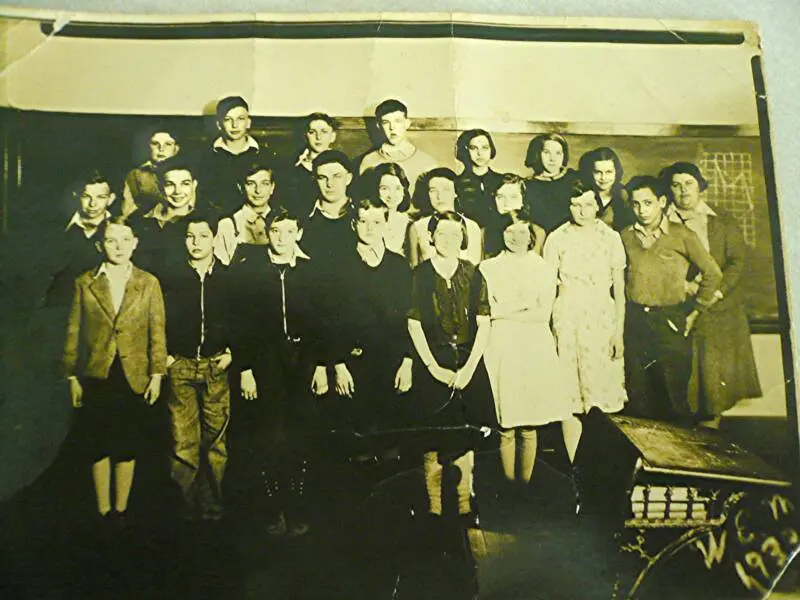
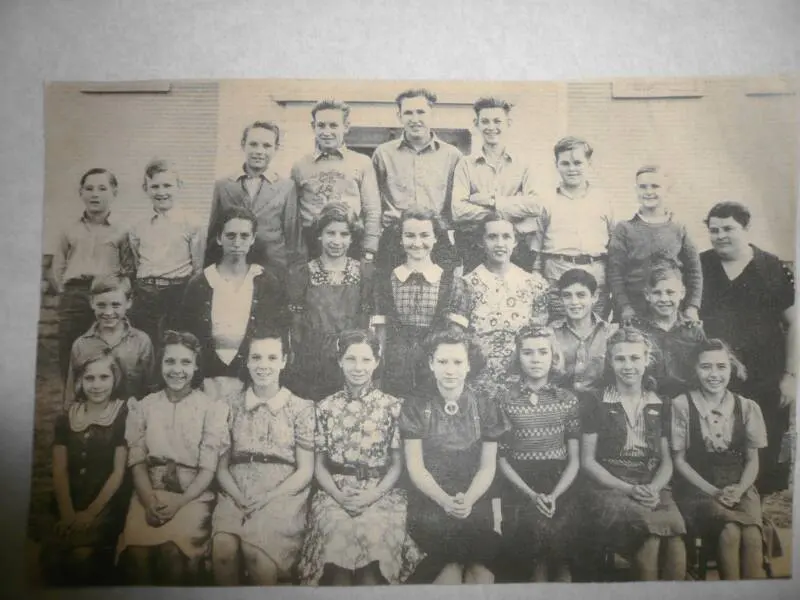
March 2009 Westwood School now a residence.
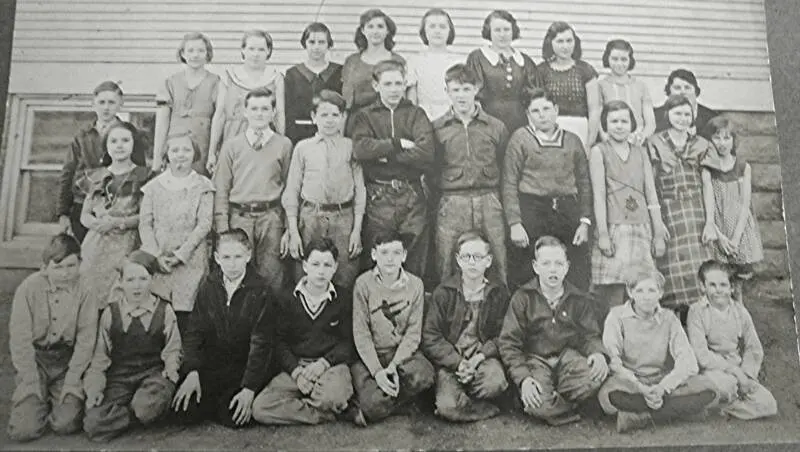
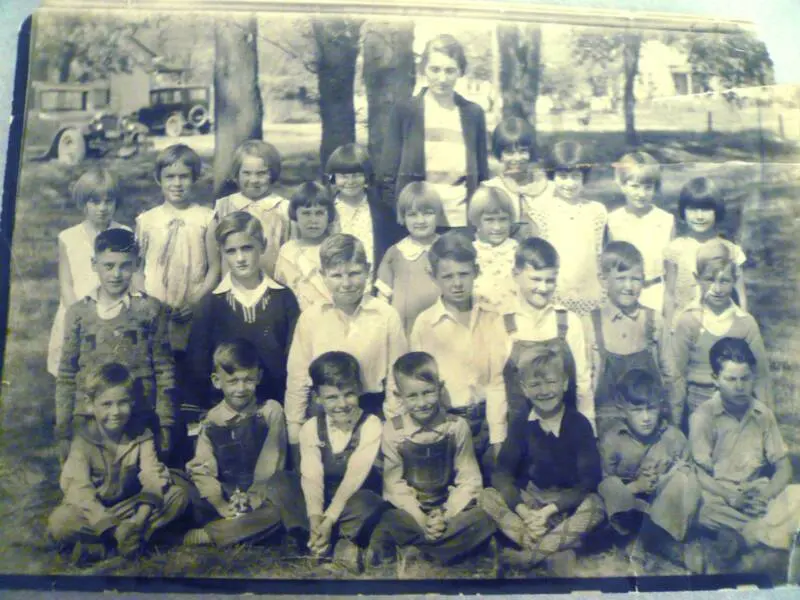
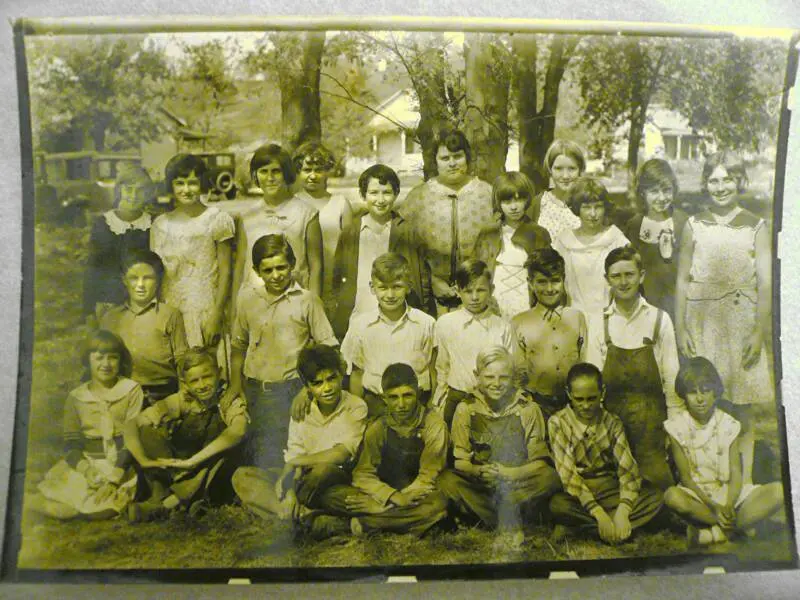
Kingston Mines Grade School 1934, 5th-8th Grade
- 1st Row: Allen Richardson, Jack Collins, Jack Lanon, Robert Lacock, Chuck Hancock, Dale Potter, Dean Potter, Tom Collins, George Gohde Jr.
- 2nd Row: Shirley Rose, Betty Scott, Paul Bitner, Lynn Hostman, Clarence Richardson, Donald Gohde, Pat McCune, Martha Ann Johns, Mabel Hunnicutt, Helen Pagen
- 3rd Row: Dave Boyer, June Richardson, Virginia Gohde, Louise Raskanp, Genevieve Sutton, Kathryn Saunders, Bernice Williams, Helen Hunnicutt, Eileen Grevey, Bernice Tindall, teacher
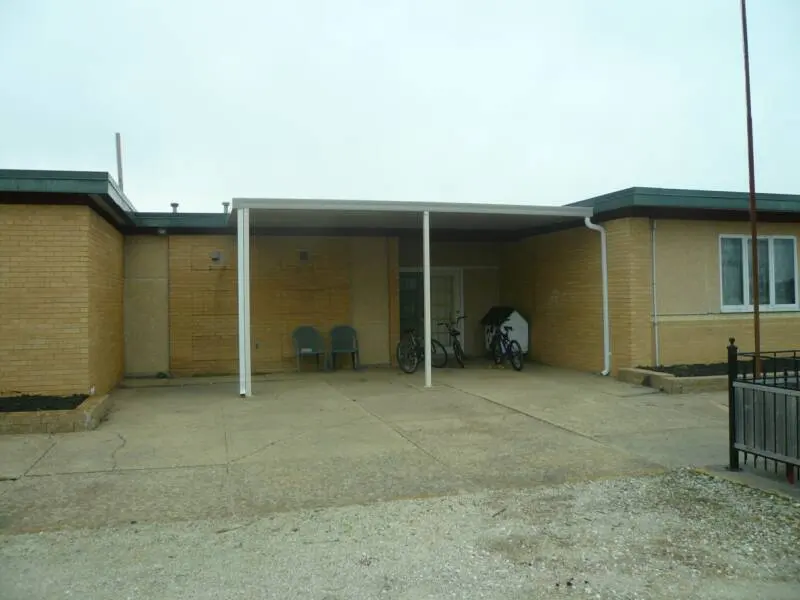
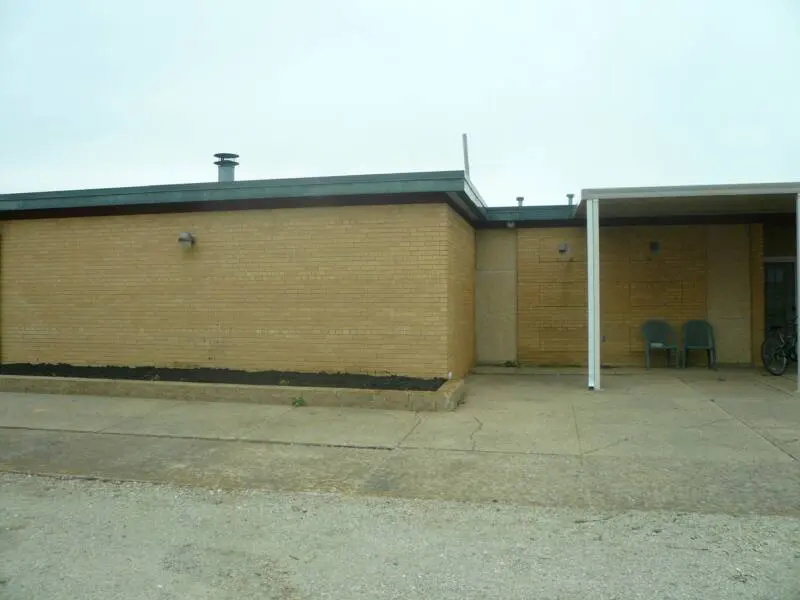
Westwood School opened in 1961 and enrolled students from Saylor, Harker's Corner, and Todd Schools. Glasford, Mapleton, Westwood, Lancaster West, and Timber Twp. became Timber Township Unit District #327.
What became of the Timber Township districts
The table at the top of this page reads like a family tree. Glasford, Kingston Mines, Centennial, Cowser and Bateman voted together into Consolidated District #205 in the early 1920s, though Cowser and Bateman later pulled out over the trouble of getting children to town. Saylor and Todd, with Harker's Corner, went into Westwood Community Consolidated District #319, whose brick school a quarter mile down the road from Saylor opened in 1961. Griggs, Scovil and Tyndall ended up in Lancaster-West, #320.
In 1969 and 1970 the pieces came back together. Timber Township High School District #159, organized in 1916, which graduated its first class of 29 in 1918, merged with District #205 and with the Lancaster, Mapleton, Westwood and Wheeler schools to form Illini Bluffs Unit School District #327. Between 1944 and 1948 the Glasford consolidation had already taken in schools from Hollis, Limestone and Logan townships. According to the table, a western slice of several Timber districts went to #324 Farmington instead.
Illini Bluffs CUSD 327 now runs an elementary school, a middle school and a high school, all in Glasford. Illini Bluffs High School, the old Timber Township High School, draws from Glasford, Kingston Mines and Mapleton, and its teams are the Tigers in orange and black. Glasford counted 866 people in the 2020 census, down from 1,022 in 2010.
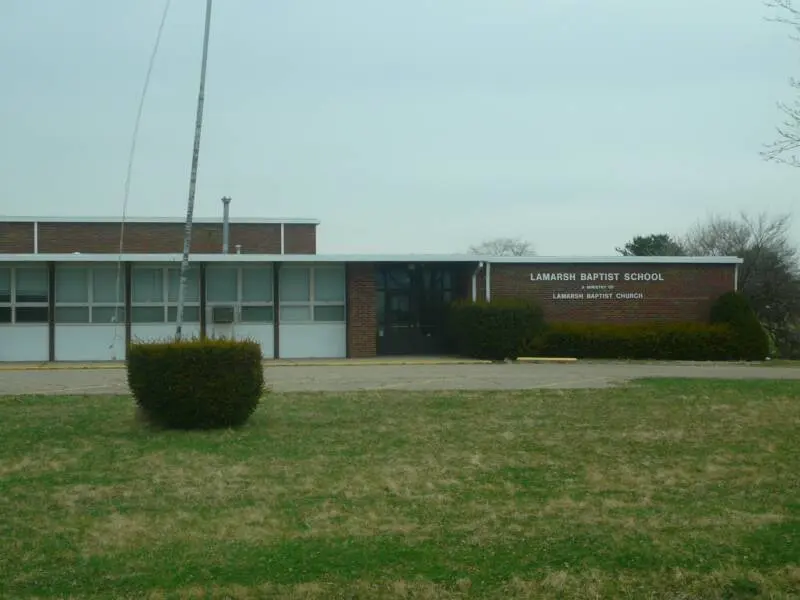
Several of the old buildings outlived their classrooms. The photographs here show the former Todd School moved but still on Todd School Road in 2001, Scovil School turned into a residence, Westwood a residence by 2009, and Lancaster West in use as a church school. The Glasford gym had a past of its own. Camp Ellis, the Army camp in Fulton County it came from, opened in April 1943 and was declared excess in 1949, the year after the gym was rebuilt beside the Glasford school.
Common questions
Where was the Saylor one-room school in Timber Township?
Saylor School, District #130, stood south of Hanna City in the N.W. quarter of the S.W. quarter of a section in Timber Township. It closed in May 1960, when teacher Frances Brewer and her pupils moved to the new Westwood Community Consolidated School a quarter mile down the road. The Journal Star reported it had schooled some 2,400 pupils.
When did the Glasford area schools consolidate?
At a special election in the early 1920s, patrons of Glasford, Kingston Mines, Centennial, Cowser and Bateman voted by a majority of 191 to consolidate as Community Consolidated District No. 205. Cowser and Bateman later withdrew over transportation. In 1969 and 1970 the Glasford schools became part of Illini Bluffs Unit School District #327.
What happened to the Kingston Mines School?
Kingston Mines District #137 began in 1840 and built a two-room schoolhouse in 1860, when the coal mines were flourishing. The building was moved in 1880 to a site overlooking the Illinois River. Enrollment fell after 1916, the district joined Consolidated District #205 in 1921, and the school was torn down after the Illini Bluffs school was built.
Which school district serves Timber Township today?
Most of Timber Township is in Illini Bluffs Community Unit School District 327, formed in 1969 and 1970 from Timber Township High School #159, Consolidated District #205 and the Lancaster, Mapleton, Westwood and Wheeler schools. Its elementary, middle and high schools are all in Glasford. The 1945 table also records parts of several districts going to #324 Farmington.
Why was there a Camp Ellis gym in Glasford?
In 1948 a gym building from Camp Ellis, near Ellisville, was dismantled and rebuilt next to the Glasford school. Camp Ellis was an Army camp in Fulton County that opened in April 1943 and was declared excess in 1949. The page's 2009 photographs show the former Glasford Grade School and gym near the end of their life.