1945 New School Laws
- H.B. 267 increases State reimbursement for transportation to $20 per student
- H.B. 684 No state aid for schools having an average daily attendance of less than seven.
- H.B. No teacher employed on a full time basis can be paid less than $1200 for the school year.
Standard Schools
Source: "The One Room and Consolidated Country Schools of Illinois," Circular No. 76 Fourth Edition, Francis Blair, Superintendent of Public Instruction, 1914 (pp. 10-12, 97-99).
Creating Standard Schools
In the early 1900s, Illinois State Superintendent of Public Instruction Alfred Bayliss decided he would try to stimulate interest in improving one-room country schools. His plan was simple. He would visit the schools, evaluate the conditions of the buildings, and assess the quality of the academic programs being offered. Those schools that met the specifications he set up would then receive a special diploma.
Bayliss' simple plan for improving rural schools, essentially a review by an outside evaluator, put in motion a movement that would impact thousands of country school students in six Midwest states during the next 4 decades. The Bayliss school improvement effort paved the way for what came to be known as the "standardization of country schools," or, more commonly, the "standard school program." It is interesting to note that today, about a century after the creation of "standards" for schooling programs, a "standards movement" is once again gaining momentum and affecting curricular and instructional practices in schools across the Midwest and the country at large.
G. Blair decided he would continue the Bayliss approach to school improvement. He hired two assistants to help with this effort: U. J. Hoffman and W. S. Booth. He asked Hoffman and Booth to develop written guidelines and requirements for the standard school program and an offshoot that came to be called the superior school program. Those guidelines were published in the form of circulars issued by the department of public instruction (DPI). Once that was done Hoffman and Booth began conducting school evaluations and spreading the word about rural school improvement. Between 1909 and 1913 the two assistants had visited country schools in 92 of the 102 counties in Illinois. They had evaluated thousands of schools and awarded diplomas and doorplates to the top schools. Some 1,681 schools had qualified for standard school designation and the very best schools, seven, were recognized as superior schools. These schools received no monetary rewards for their achievements, only doorplates and diplomas. Despite the lack of funding the popularity of the program expanded to include upgraded country as well as graded town schools. To qualify as a standard school in Illinois in 1913 schools had to follow these guidelines.
- The teacher had to be paid at least $360 per year. Superior schools had to pay their teachers $480 per year.
- There must be light from one side of the room, the children’s left. No light from the other three sides.
- There must be about twenty square feet of floor space for each pupil seated in the room, and there must be a certain relation between the floor space and the number of square feet of light in the windows.
- There must be no direct heat from stoves.
- Every stove must be jacketed and the ventilation must secure fresh air in the room.
- There must be cloakrooms.
- Good blackboards must be provided.
- There must be a vestibule to prevent direct communication with the cold air on the outside.
The county superintendent is the inspector of the schoolhouses in his county, and he is to determine whether the schoolhouse complies with all the requirements. If it does he marks it a standard school. If the directors fail to meet the requirements, the county superintendent can withhold the distributable fund until they do so comply.
New Unit Districts Recently formed in Peoria County
Heritage Museum in Princeville, Illinois
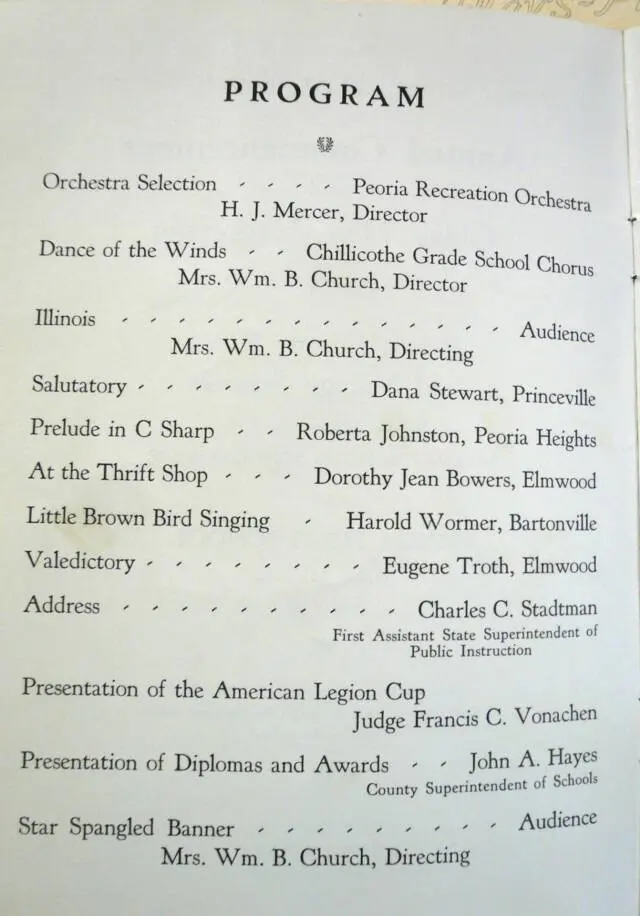
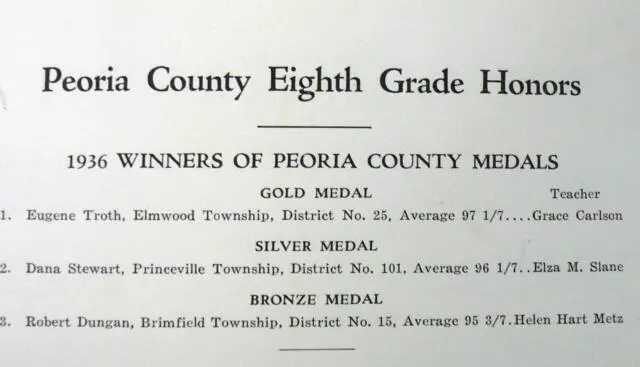
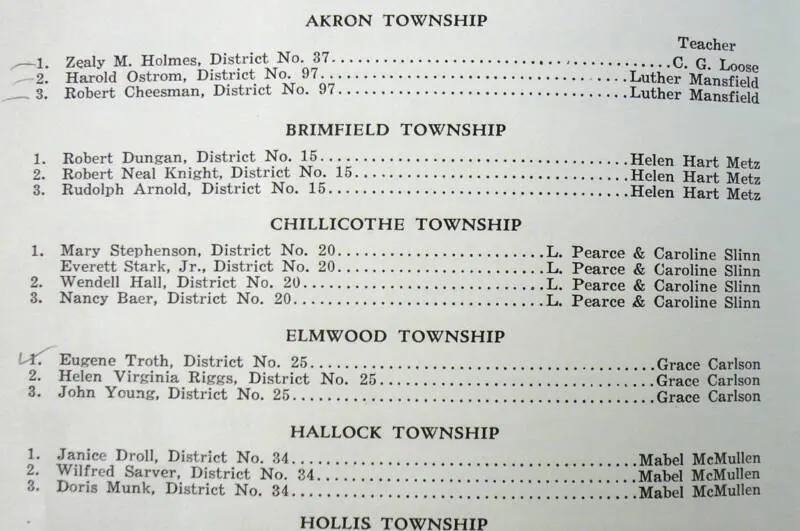
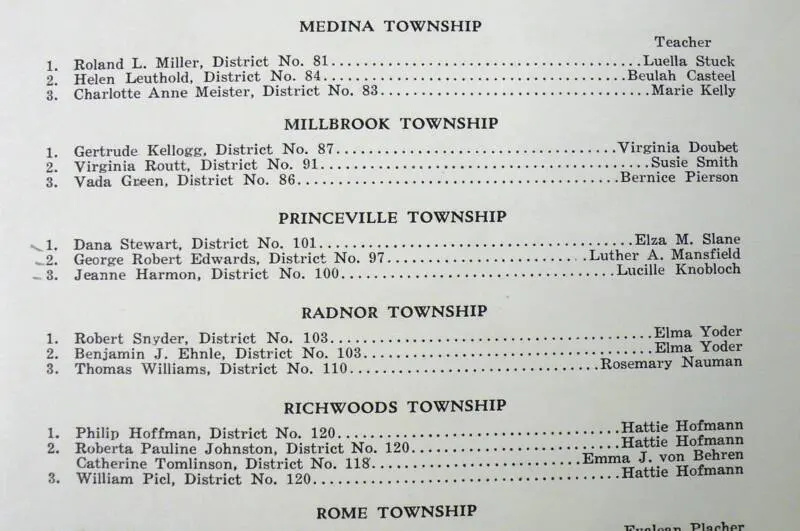
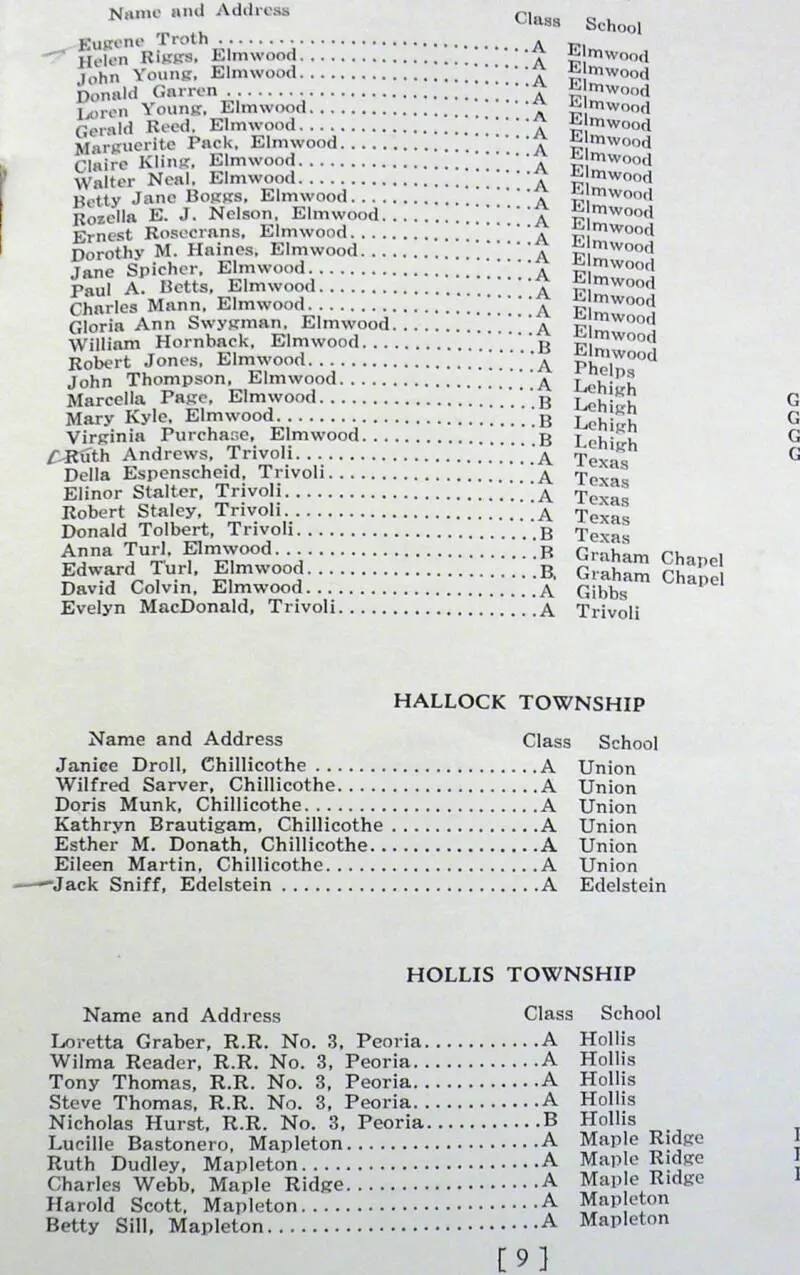
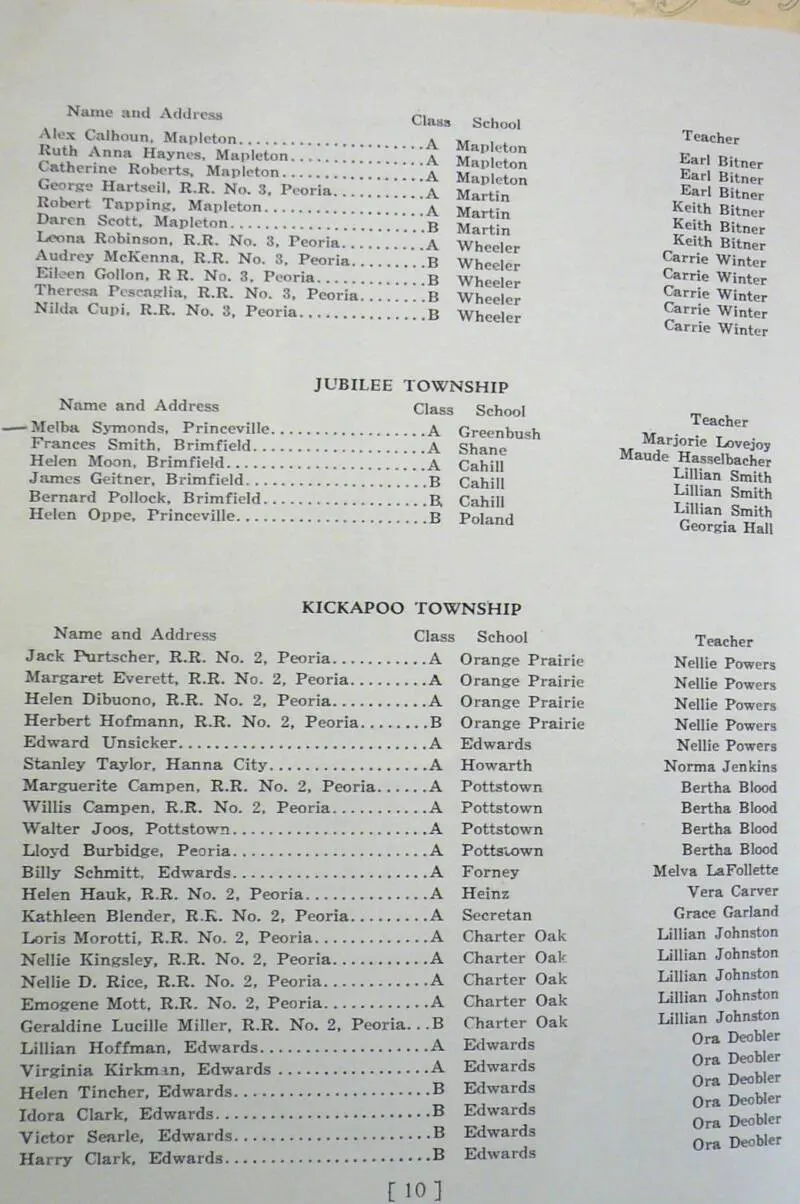
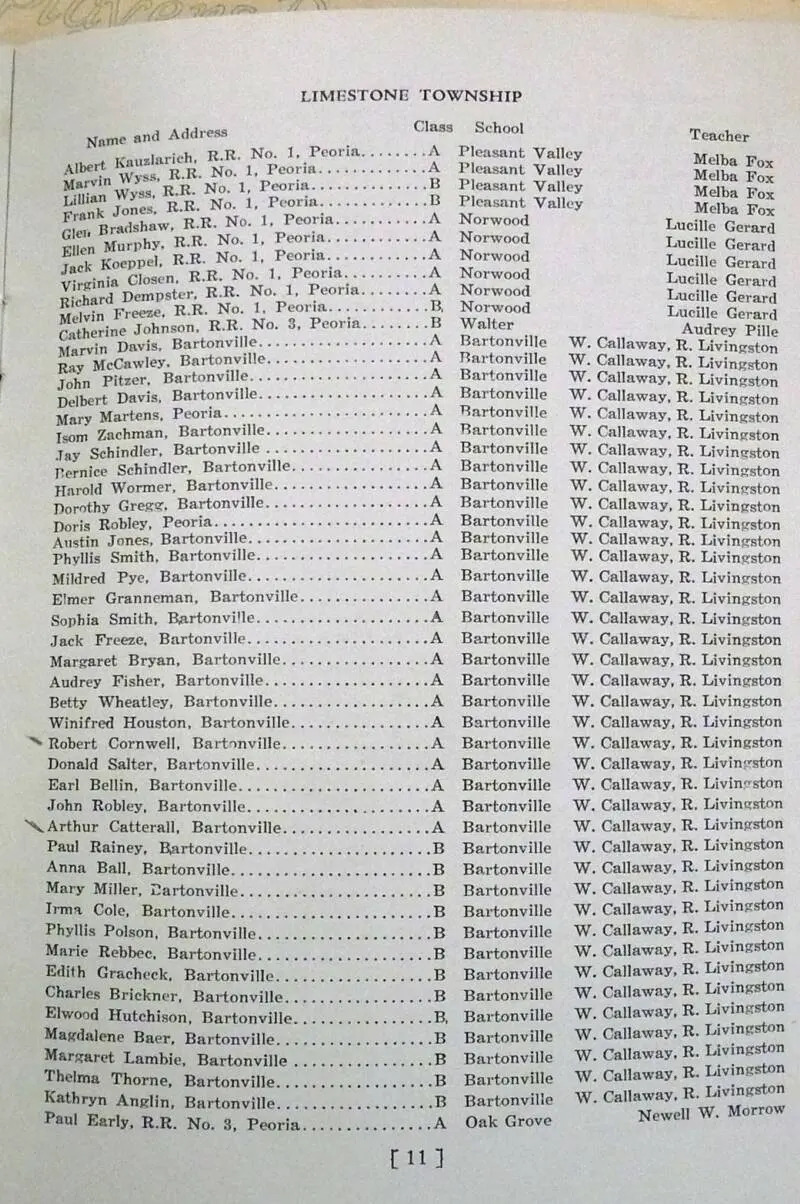
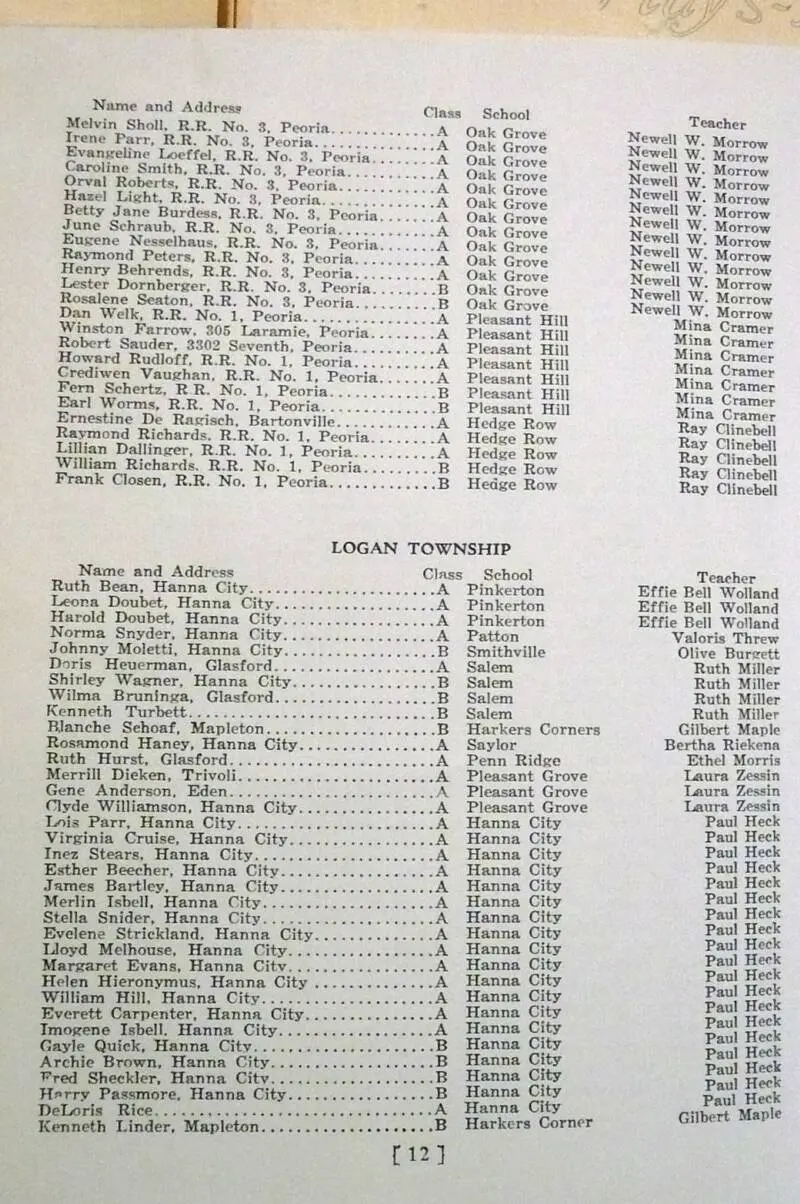
Honorable Mention Students
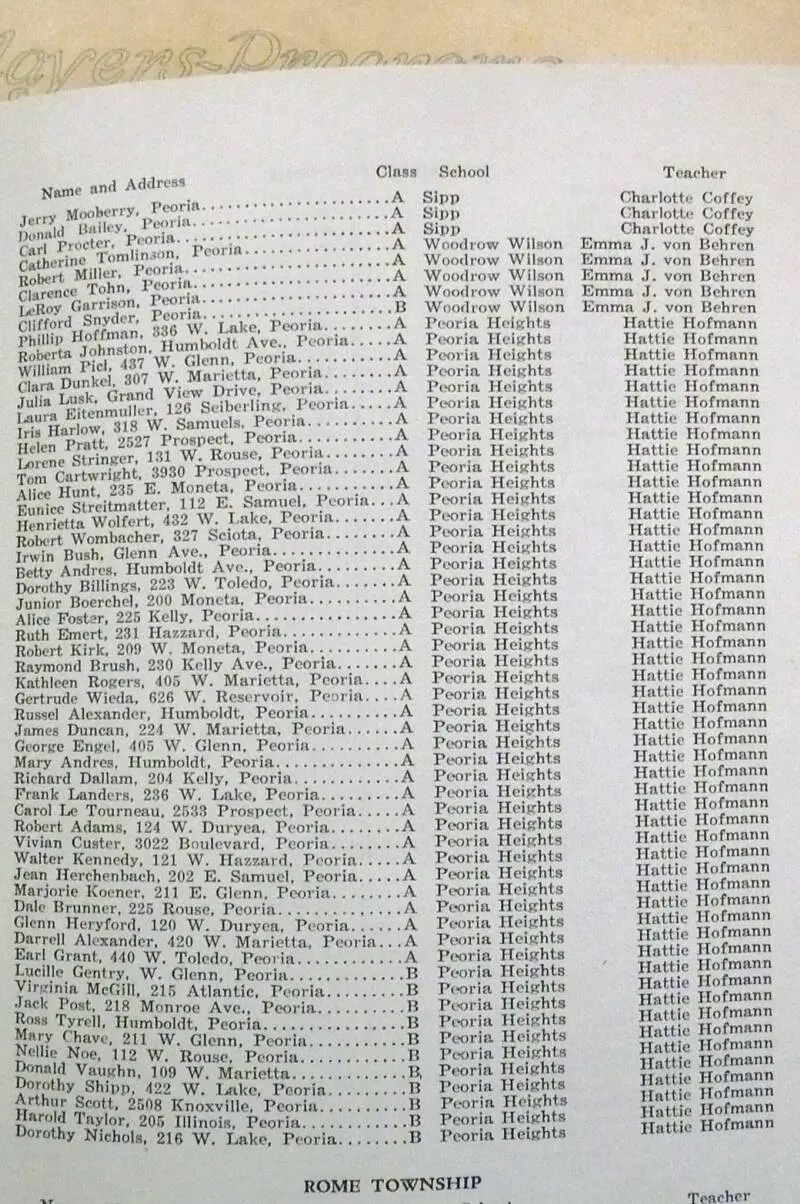
(Eighth Grade students from county and rural schools were tested by the County Supt. before 8th grade certificates were issued.)
How the law emptied the country schools
The three 1945 bills at the top of this page look small, but together they told the little districts their time was short. A school averaging fewer than seven pupils lost its state aid, a full-time teacher could not be paid under $1,200 a year, and the state put more money behind busing children somewhere else.
The same legislature went further. In 1945 it directed the counties to set up school survey committees to draw new district lines. Madison County, for one, appointed a seven-person committee that year, and by 1947 more than half of its 135 districts were still one-room districts. In 1947 Governor Dwight Green signed House Bill 575, which set the rules for community unit districts, the kindergarten through twelfth grade systems that swallowed most country schools in the next twenty years. The clipping above shows the last wave of those unit districts forming in Peoria County. Limestone Community High School District 310 near Bartonville is an earlier local example, created by a vote on February 5, 1949.
Consolidation never quite stopped. The Illinois State Board of Education counted 62 more consolidations between 1983 and 2017, mostly rural, and Illinois still had 852 school districts in 2017, one of the highest counts of any state.
The standard school movement on this page came first. The figures quoted above, 1,681 standard schools by 1913 and seven superior ones, show how far that program reached before the laws turned to consolidation. For a one-room school you can visit, the Princeville Heritage Museum at 325 N. Ostrom Avenue in Princeville keeps the Akron Townhouse School, built in 1900, on its grounds, alongside the displays pictured here.
Common questions
What did the 1945 Illinois school laws change for one-room schools?
Three 1945 bills hit small rural districts directly. H.B. 684 ended state aid for schools with an average daily attendance under seven, another bill set a $1,200 minimum yearly pay for full-time teachers, and H.B. 267 raised state transportation reimbursement to $20 per student. The legislature also directed counties to form school survey committees that year.
What was a standard school in Illinois?
A standard school was a country school that met state rules first pushed by Superintendent Alfred Bayliss and continued by Francis G. Blair. In 1913 it needed a teacher paid at least $360 a year, light from the pupils' left only, about twenty square feet per pupil, a jacketed stove, cloakrooms, good blackboards and a vestibule.
How many Illinois schools earned standard school status?
Between 1909 and 1913 the state assistants U. J. Hoffman and W. S. Booth visited country schools in 92 of the 102 Illinois counties. Some 1,681 schools qualified as standard schools, and seven were named superior schools, which had to pay their teachers at least $480 a year. Winners got a diploma and a doorplate but no money.
When were community unit school districts created in Illinois?
In 1947 Governor Dwight Green signed House Bill 575, which set the criteria for community unit school districts covering kindergarten through high school. County survey committees, ordered by the legislature in 1945, drew the new boundaries. In Peoria County most remaining country districts joined unit districts by 1969, such as Illini Bluffs #327 and Princeville #326.