1945 Richwood Township Schools and Consolidation
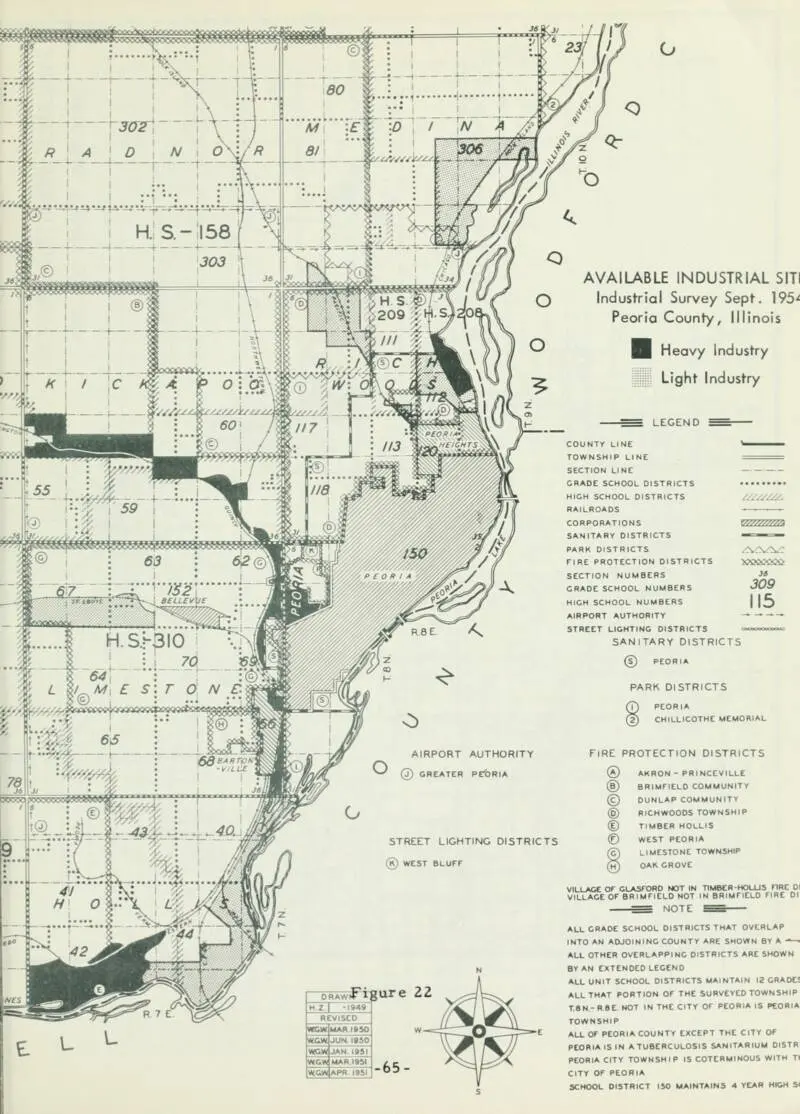
- Kellar School, District #111: 1965 Peoria #150
- Gardener School, District #112: 1965 Peo Heights #325
- Hines School, District #113: 1965 Peoria #150
- Reservoir Heights, District #114: 1965 Peo Heights #325
- Richwoods School, District #116: 1946 #303 Wilder-Waite; 1969 #323 Dunlap
- Sipp School, District #117: 1965 #150
- Woodrow Wilson School, District #118: 1965 #150
- Kingman School, District #119: 1928 #10
- Peoria Heights School, District #120: 1969 #325
Kellar School, District #111
Kellar School #111 of Peoria County and in Richwoods Township, was located about two miles northwest of the present site, on the Stringer farm. The school was known by the name of Stringer and was on the Mount Hawley Road as is the present Kellar School. This school was built back about 1858 and was used until 1890. The building was a frame construction, very like the other schools of that time, with benches, a cannon stove in the center of the room and three school terms a year. This school grew more and more out of date and unsatisfactory, and that coupled with the fact that it was way over to one side of the district, prompted the directors to hold a meeting of the voters for the purpose of building a new building in a new location.
In 1890 this meeting was called and the idea pleased the majority of the voters, so a tract of land was purchased from Mr. Giles and the new building erected. The new school was named the Beaconsfield School in honor of the Beaconsfield Stock Farm, located nearby. The school was used for 20 years and kept very modern throughout that period. In 1910 during an electrical storm, the building was struck by lightning and completely demolished. The fire took place in November. The pupils were without a place to attend. The Frye School district invited them to their school until better arrangements could be made.
The distance was too great however so after attending this school for a few weeks, a private dwelling was secured by the district for the pupils to finish the year. In 1911, the building, which has been used since that time, was built. It was a nice large modern building and has been improved several times since to keep abreast with the times. In 1930, the room was divided so as to accommodate two teachers. The lower grades are kept on one side and the higher grades on the other. The partition was not put completely through the room and is not as satisfactory as it should be, but changes are being planned at the present time, which will replace it. The school is equipped with a heater, has a basement and a large playground. The library, reference works, dictionaries, and maps are modern and in good condition.
Richard Hayes, Superintendent of Schools 1930
In 1936 a two-room addition was added and in 1950 two more rooms were added. In 1954 $137,000 was spent on a four-room addition. This completed the present Kellar East.
In November 1959 a bond was issued to build a new Kellar West at 6327 N. Sheridan Road. Work was started on Kellar West in 1960. July 18, 1977 Kellar West became Lindbergh School. Until 2009 classes were held in the two buildings (Kellar Central / Kellar East) with Mt. Hawley Road splitting the campus. A new addition in 2009 was added to Kellar Central and now all students currently attend Kellar Primary (1-4) School on the west side of Mt. Hawley Road. Plans for the “old” Kellar East are unknown.
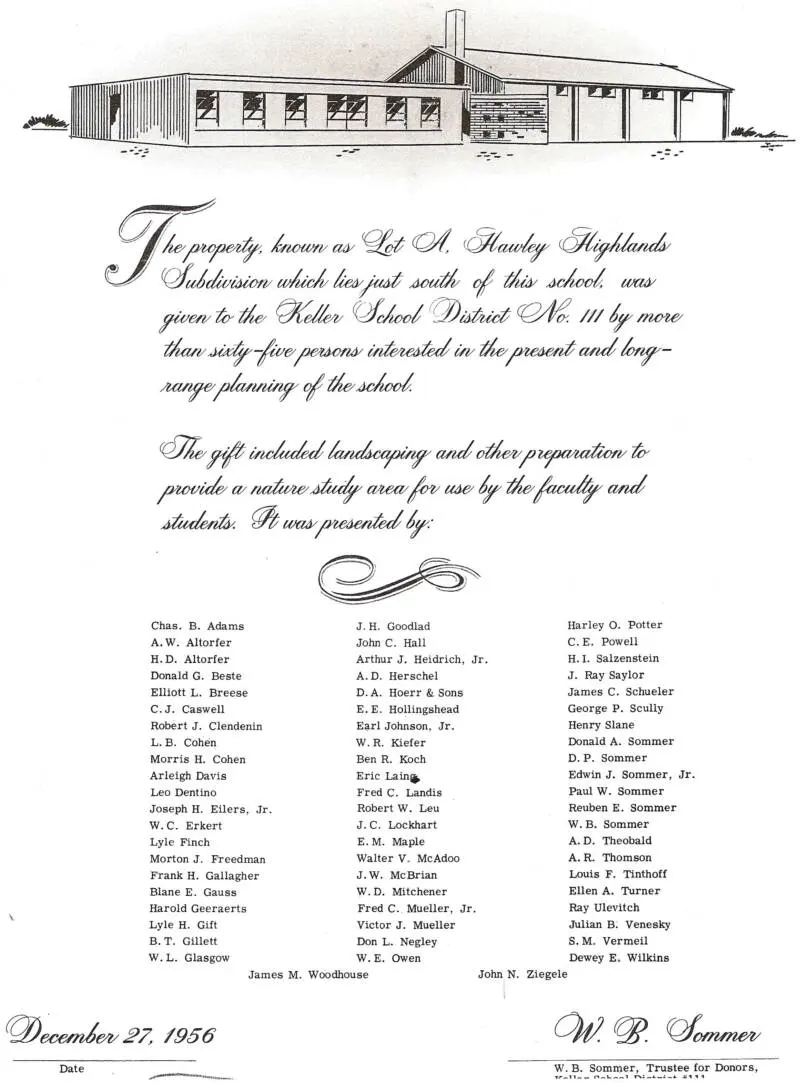
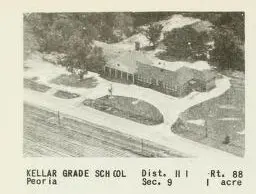
Pictures from 1950's
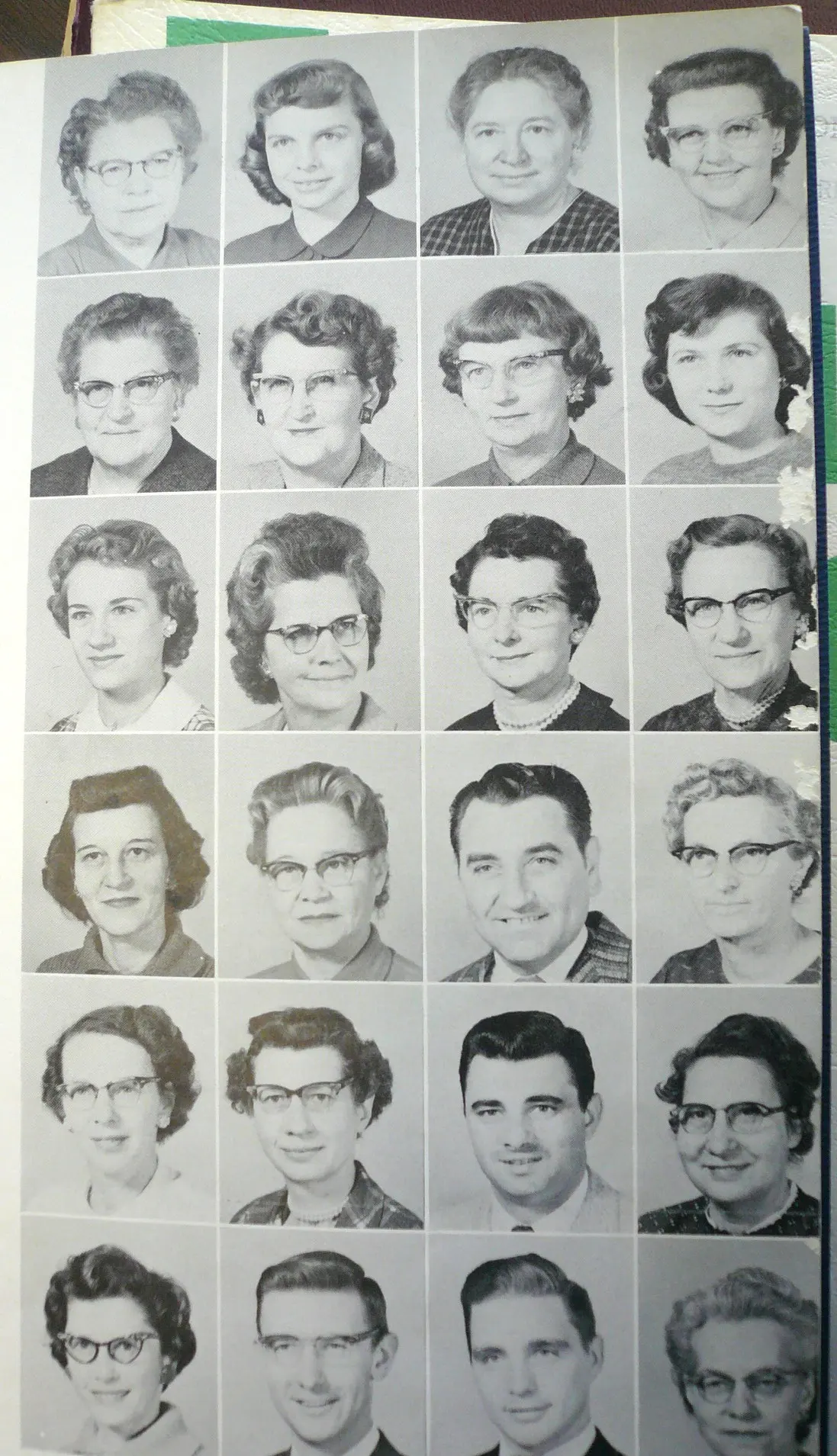
- Mrs. Mary Grimm, 1st
- Mrs. Janice McCormick, 1st
- Mrs. Geneva Cruse, 1st
- Mrs. Lois Jett, 1st
- Mrs. Thora Young, 2nd
- Mrs. Jan Busk, 2nd
- Mrs. Louise Dierker, 2nd
- Mrs. Elizabeth Baldwin, 2nd
- Mrs. Judith Meinders, 3rd
- Mrs. Aber Lemaster, 3rd
- Mrs. Ruth Stone, 3rd
- Mrs. Mary Doyle, 4th
- Mrs. Aldene Leach, 4th
- Mrs. Luella Blenz, 5th
- Mrs. Will Garvin, 5th
- Mrs. Rosetta Deason, 6th
- Mrs. Connie Deatherage, 6th
- Mrs. Kathryn Culver, 6th
- Mr. Francis Malpede, Math-Coach
- Mrs. Bernice Bates, Science
- Mrs. Dolores Harris, Lang. Arts
- Mr. Ward Harding, Social Studies
- Mr. Wesley Sandness, Music
- Mrs. Lillian Beck, Secretary
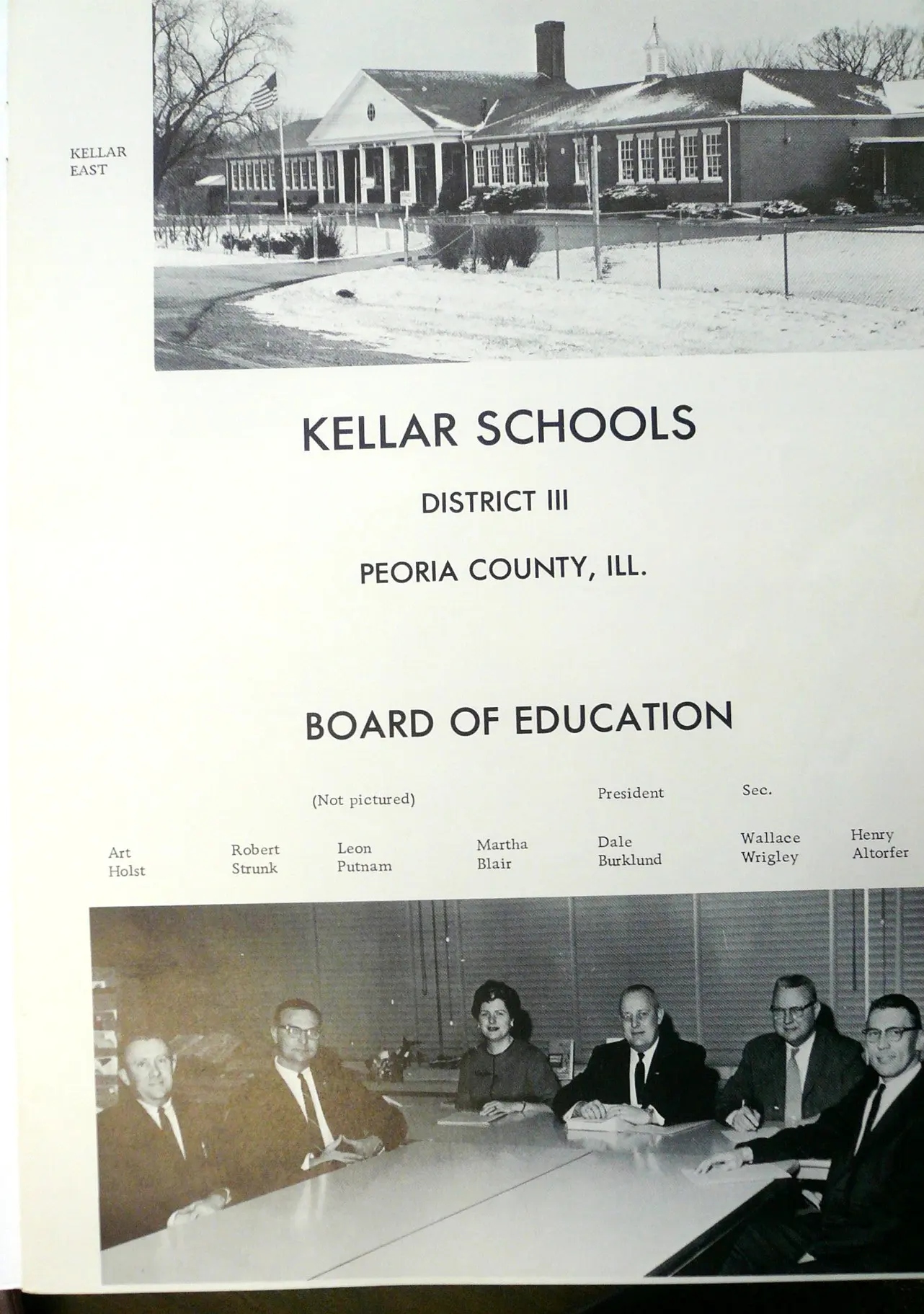
Art Holst, Robert Strunk, Martha Blair, Dale Burklund, Wallace Wrigley, Henry Altorfer. Not pictured Len Putman. President Dale Burkland. Sec. Wallace Wrigley.
Gardener, District #112
The first school in the present Gardener District was called the Stafford School. It was conducted in a log cabin on what is now the Krause farm.
That part of District 112 now known as the Plat, more properly called Long Shore Park, was incorporated in 1825 as “Detroit”. Four men then owned all the property in the village.
The present site of the school building was purchased of William Barton for $100.00. This family is the one after whom the village of Bartonville is named. The ground was bought January 3, 1874. The present building is the second on this site. Its predecessor, a framed one room building, served the community some thirty years.
In 1896, the district was known as District #2. The assessed valuation of the property was $43,990.00. The salary paid the teacher was forty dollars per month. Said teacher had to build her own fires, sweep and dust the schoolhouse and hoist the flag on the flagpole except on violent stormy weather. School hours were from nine o’clock a.m. to four o’clock p.m. of the same day. So reads the record of the school directors of that day. All through the record appear the names Krause, Gauwitz, Schielein, and Krempp with varying initials.
In 1931 the assessed valuation of the property was $760,000.00, said to be one of the highest valuations per pupil of all rural districts in the state. Two teachers and a fulltime janitress were employed. The ambition of the directors was to be able to win and display the coveted label “Superior School.”
In 1947, the school was enlarged. A $75,000 addition included two classrooms, a kindergarten room, a gymnasium, the principal’s office, and new toilet rooms.
In 1970 Gardener School had nine classrooms, and an enrollment of 203 pupils. Mr. Gerald M. Brookhart was the principal.
Gardener School closed in 1965 and Tousley-Iber Co., general contractors, later purchased the building. The building’s top floor where the four classrooms once were contains the company’s offices. What was once a gymnasium is now a warehouse. The basketball hoop remains out back for the neighborhood children. One wing is leased and the downstairs is used as storage.
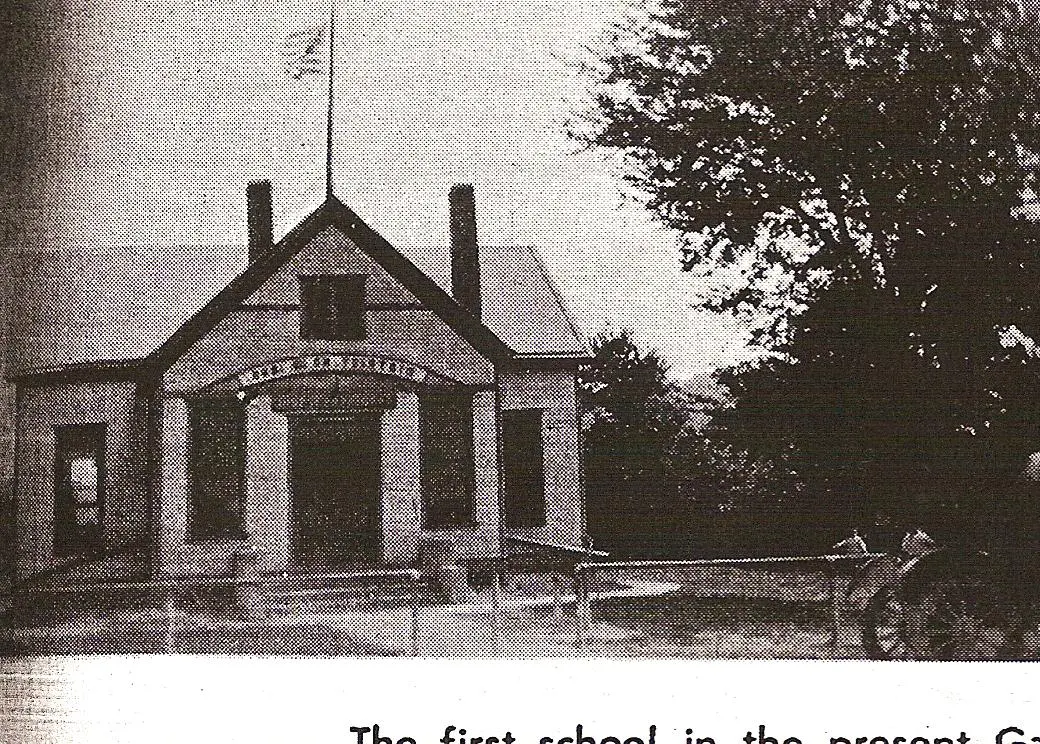
Hines School, District #113
The first schoolhouse in District 113, originally District #3, of Peoria County, was a log cabin situate between Knoxville Avenue and the old Fair Grounds. The C. J. Off property is located on the site at the present time. The building was erected in 1840 and was far from being modern. The school was equipped with a set of benches, a couple small windows and a cannon stove. The stove was the only really modern thing about the building and at that time, a stove was almost considered a luxury, fireplaces being used in most places.
About twelve years later the log cabin was replaced by a brick building. The new building was placed on the Fulton property, across the road south of the old site. This building had more light than the old one and was much larger and served the community for 18 years. It was considered too small for the ever-growing community.
Jacob Fry donated an acre of land to the school district for the purpose of locating a school on it. This ground is part of the present site. A frame building was erected here in 1870. It was more modern, larger and was in use for 20 years and probably would have been used much longer but for the fact that it caught on fire in 1890 and was destroyed. This building was equipped with seats and desks and was built securely enough that it could be kept warm with the old stove that stood in the center of the room.
A short time later another frame building was erected. Two years after this, the school received the first certificate from the County Superintendent of Schools for the best and most sanitary schoolhouse and yard. A short time after this the school started experimenting in gardens. They raised a garden, the pupils keeping it in shape in out of school hours. They received the second prize one year on their efforts and the first prize the next year. The money from prizes and the produce which they sold, was used to purchase an addition to their library.
In 1920 the building was enlarged into a two-room school. An addition was made to the grounds also; approximately 1 acre. The building was modernized and renewed in every way and a large playroom under the building installed for bad weather. In 1917 some changes were made necessary by the passing of school regulation laws. These changes were made and some new equipment from time to time since has been added. The school is at the present time beautifully located on a grassy plot with large trees around the outside furnishing shade for the kiddies during the hot days of September and May.
John Hayes, Superintendent of Schools 1930
The above school later had two rooms and an annex added. Still later, a two story brick school was built. Currently on this site is the Seventh Day Adventist Church on Knoxville Avenue.
In the 1940’s a new brick building was constructed at the present location (4603 North Knoxville). It remained a kindergarten through eight grade school until 1986. Hines now serves children from kindergarten - fourth.
Hines School #113 became a part of Peoria District #150 in 1965 after Richwoods Township voted to annex to the city of Peoria in 1964. The annexation agreement passed by 336 votes!
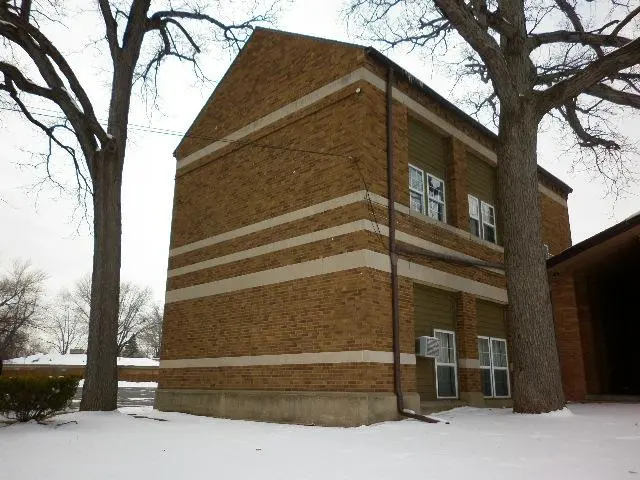
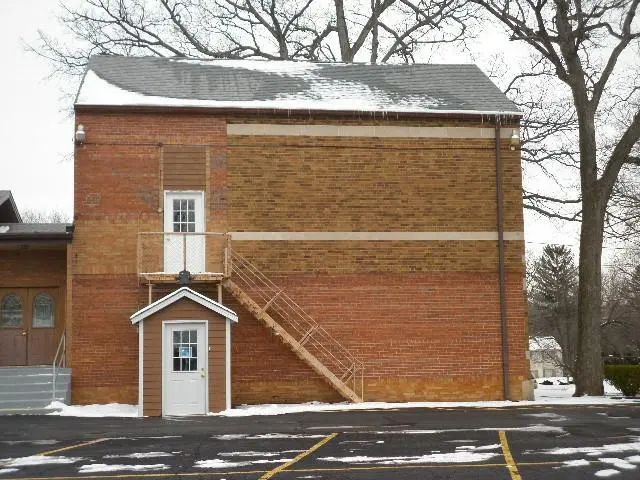
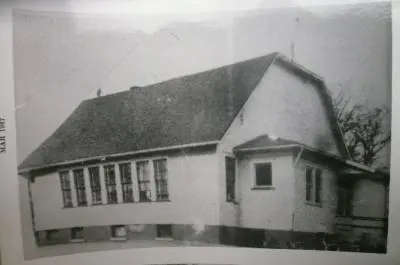
Old Hines School located 4019 N. Knoxville Rd. burned to the ground in 1956.
Reservoir Heights School, District #114
The Reservoir Heights District 114 started in 1905 and ended in 1928. Before 1905, the children of the district went to the Glen Oak School and in 1928, the district was taken into the city of Peoria and became part of District #150.
In 1905 when the school was built, the attendance was not quite thirty but each year found a large increase and by 1913 it filled so full that a primary room was necessary. This was built and by the next year the two rooms were again crowded but this crowded condition was not remedied until 1921 when another addition was made. This addition was not adequate or properly arranged so as time went on, additional improvements and a room was added. In 1928 when the district was annexed to the city, a few more changes were deemed necessary and these were made.
John Hayes
At the former Reservoir Heights location, a new school was constructed and is now called Washington Gifted School.
Richwoods School, District 116
In a little log house, with split log seats and desks, and very poor lighting, surrounded by a grove of locust trees, the education of the pupils of district 116 of Richwoods township started. One of the first students of this school, Mrs. Rebecca Frye was still living in the district until recently.
In 1860, a new building of frame construction was erected on the site eight rods east of the old school and on the South and opposite side of the road. This building was larger and has several more windows in it. The seats were more comfortable because they had backs, however the backs were so straight that we of the modern age would find them very uncomfortable.
One night in 1906, when everyone was sleeping in the neighborhood, the building caught fire and when observed in the morning, very little was left so a new school was commenced at once and complete in the same year. School was held in this building for six years and then due to lack of pupils to attend, it was closed and reopened six years later in 1918 for the spring term. At this time the necessary improvements were made and school has been running from that time with from six to fifteen pupils.
Robert Hayes, written in 1930s
In about 1945 the teacher of Richwoods School was called away suddenly to be with her injured husband, a World War II soldier. In need of a teacher for the fall term, the directors asked Mrs. Mabel Pierce, a former teacher, to take over for the year. They offered her $140 a month. She was to be one of the highest paid teachers in the area. She accepted on the condition her son, Larry, could attend the school also. So Larry, who previously attended Alta, became a Richwood’s student. Shortly after the school year began, Alta School was destroyed by fire. Those students had a two-week vacation until school resumed in the nearby Masonic Lodge. Like any school age child, Larry was really unhappy when his former schoolmates received an unexpected vacation. Richwoods School was located on the corner of Pioneer Park and University. After its doors were closed in 1946, the building was moved about 1/2 to 1 mile south on University. A couple lived there for a few years until the house burned to the ground. Richwoods School was a true one-room schoolhouse, coal fired stove, a pump well (which wasn’t used) and boys and girls “rest rooms” out back. (Larry Pierce: Alta School, Richwoods School, Wilder-Waite School; California)
Sipp School, District #117
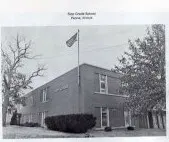
Robert Sipp built this home for his family on farm land which is now commercially developed. Weisser's Jewelry and Optical is located where the house once stood. Robert is left. Far Right is William Sipp, Robert's brother. Mrs. Jeannette Sipp is holding Earl and at left is her daughter Helen.
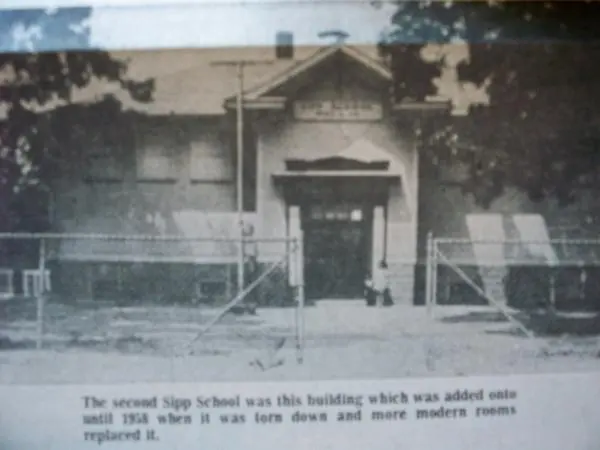
Before the year 1850, the early settlers of this locality sent their children to the Fulton School, which was located near the south entrance to the Fair Grounds. Here children came for miles to study the three “R’s”.
In 1853 Spears School was built on what is now the William Nelson farm down in the field just east of Mr. Frank Apple’s home. This was a brick building, approximately eighteen by twenty-four feet.
This building was afterwards abandoned and the district divided. It seems before this time the district boundaries extended much farther south and east. Two new buildings were constructed, one south in Werkle’s neighborhood and called the Loucks School, and the other, the Sipp School stood on the southwest corner of Robert Sipp’s Farm. Seemingly, this was an inconvenient location, and Adam Sipp deeding the land, the school was soon moved nearer the center of population on its present site.
Many community affairs were held in the school building. Sunday School services were made interesting for a number of years. A grange was organized in the community and meetings were held at the school. Before this time a Literary Society was organized and many debates were held.
On the sixth of November in the year 1926, the present two-room modern equipped school building was dedicated.
Robert Hayes, Superintendent 1930’s
From Journal Star April 20, 1967
The first Sipp School cost $600 and stood in southwest corner of Robert Sipp's farm. That school burned and a new school was built at University and Glen. Several additions were added to that white frame structure which was torn down in 1958 and replaced with more modern classrooms. The school has grown from 138 students in 1949 to more than 800 by 1959.
From Journal Star 1957
Because of the increased growth north of Sipp School another school has been built to handle the overflow. The new school, Rolling Acres, has six classrooms and nine more were added in the summer of 1958.
1959 Journal Star
Voters will go to the polls to vote on a $160,000 bond issue for additions to both Sipp and Rolling Acres. If passed, Sipp will get six more classrooms in a separate building that eventually will be used for the primary grades. And five more rooms will be added into Rolling Acres School.
Right now, five more rooms are being added at Sipp including three classrooms, a library and a special education room in addition to a faculty room and new office area.
The population of the Sipp District is now around 5,500. Superintendent Robert Boggs said, “We're already talking terms of a third school. The growth path to the north and west and that would be a proper location for another school.” Ten years ago this area in the Sipp District was country. Some think it still is. In a few more years there won't be a cornfield in sight. That's why the building of schools and the additions to them goes on and on and on.
1961 March 5 Peoria Journal Star
Spartan Senior Grade School is the name selected last night by the Sipp-Rolling Acres School Board for the district's new senior grade school, which will open in September.
Supt. Robert Boggs said the name had been suggested by the pupils who had been using the name “Spartans” for their basketball teams.
In a reply to a letter from the Richwoods Community High School Board, the Board went on record as being opposed to Illinois House Bill 1063, which deals with annexation to Peoria without annexing to the school district.
Journal Star January 9, 1962
A decision to purchase 3.3 acres of property from Exposition Gardens for $15,000 as the site for another grade school was reached last night by the board of education of Sipp-Rolling Acres School District.
The board began negotiations with officials of Exposition Gardens last October for the purchase of the property on Northmoor Road at the southwest corner of the Gardens. It will be ready for use in the fall of 1963 if voters approve a referendum to issue bonds. No date has been set for a referendum.
Robert Boggs, superintendent of the school district, said only the legal terms have to be worked out to complete the transaction. He said both school board and officials at Exposition have agreed on the $15,000 price.
There are now three separate schools: one in two buildings at Sipp, University and Glen, and two at the Rolling Acres site.
Sipp has a primary school with grades 1 and 2 and an elementary school for grades 3 through 6. Rolling Acres School in Rolling Acres has grades 1 through 6, and the new Spartan senior grade in Rolling Acres has grades 7 and 8.
Journal Star July 15, 1964
The Sipp-Rolling Acres Board of Education Monday evening adopted its 1964-65 budget of $689,562.78. The budget of $503,379 and the major amount of the increase is in salaries.
Charles Ullrick was asked to comment on the annexation of the school district. “If the election carries, you're out of a job,” he said. “As I understand it, you would then have the right to appeal under House Bill 1063. You can't do anything legally until after the election when you can tell whether the people want to retain their own schools.”
There was some concern voiced over the proposed $480,00 bond issue for additional classrooms to be voted on Oct. 17. It is conceivable the money could go to Peoria District 150 if annexation passed. Board members, however, felt that the dissolution of Dist. 117 and its incorporation into Dist. 150 was highly unlikely.
November 21, 1964
Annexation vote passes by 336 votes. District 117 School Board is dissolved and District Schools 117 Sipp, Rolling Acres, Spartan, and the new Northmoor become part of District 150.
Journal Star 1984
Rumors have gone around for years that Sipp School would be closed. This year that rumor became fact: The end of school tomorrow spells the end of Sipp, on the southwest corner of University and Glen. Sipp has grown from a one-room school in the country to a modern school at one of the busiest intersections in the city.
District 150 administrators say that Sipp is on one of the most undesirable school sites, what with the commercial development and traffic around it.
Journal Star
All of the Sipp School property safely belongs to District 150 according to the district's legal counsel.
When Adam Sipp donated land for a school in 1859, the deed contained a statement saying that the land would revert to Sipp or his heirs if the land was ever used for anything other than a school.
But school attorney David J. Walvoord said the clause has expired, due to a state law limiting such clauses to 40 years. Unsure when the law was passed, Walvoord said that it was in the 1800's, so the clause would have been invalid by 1940 at the latest.
In addition, Walvoord stated in a letter to the Journal Star that the title District 150 received to the Richwoods area schools didn't contain any reverters.
The clause covered nearly four-tenths of an acre of the present Sipp site, according to Walvoord. Subsequent acquisitions have added about four more acres.
Due to the school's closing, Sipp pupils will be assigned Lindbergh, Rolling Acres, Woodrow Wilson and Thomas Jefferson Schools next year.
Sipp School was demolished in 1985 and Chili’s now occupies the site.
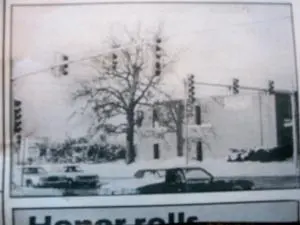
Journal Star Feb. 20, 1985: Demolition of the building that formerly housed Sipp School, at the corner of University and Glen, was completed last week. Construction of a new Peoria Toyota-Volvo automobile dealership is slated to begin at the site this spring. The District 150 school was closed in 1983 because of declining enrollment.
Woodrow Wilson, District #118
The earliest records which we have and which appear to be the earliest record of the school in what is now District #118, go back to 1851. This building was located on what is now known as the Knoxville Road. This school was followed in the 1858 by another larger frame building on what is now known as Easton Road. This building stood on the edge of the timber, which then covered the greater part of what is now known as District #118. It was in this building that boys gathered to join the ranks when the great Civil War started.
The first building, built purposely for uses as a school, was located on Easton Road, about forty rods from the Knoxville Road, on land donated by a Mr. Thompson, with the same clause often placed on land similarly donated in those days, and that was, should the school ever be discontinued, the land would go back to the estate. The district limits at this time were what is now Nebraska Street on the South, Sheridan Road on the east, Gale Avenue on the West and the north was one mile out on Sheridan Road west to Gale Avenue.
According to records, Sunday School convened in this building as early as 1860, Judge Loucks conducting the school. This school held the banner of Peoria County for a long time and was named Loucks in honor of the Judge. Other social activities included the spelling matches, so well liked and attended in those days, singing school, debates and occasionally a program given by notables of the time.
In July 1898, due to the increase in population, an addition was made to the school building. In 1903 this building became still more inadequate so a new building was erected on what is now the corner of University and McClure. This new building had the Honorable John A. Hayes, now County Superintendent of Schools as its first principal.
A few years later the city of Peoria annexed part of this territory, and leaving District #118 without a school; the children of the district were sent to the Loucks School, now a part of #150, and the interest on the money which the school district had, paid their tuition. Later it was found necessary by the city to charge $85.00 per pupil and then this was found inadequate, so the people of the district got disgusted and decided to start another school of their own. They tried to get their old site back but it was impossible to do this so another site was secured and school building erected in 1925. The building was made modern in every way each year since, changes have been made to keep it absolutely modern and up-to-date.
John Hayes
When the land on Easton Road was no longer available, the trustees then purchased a 1/2 acre on the north side of Forrest Hill Avenue and built the first District #118, Woodrow Wilson School, in 1925. The land lying north of Forest Hill had been the property of Jacob and Ellen R. Darst in the early 1800’s. They sold most of their farm to William Finnell for the sum of $9000.00 in November of 1874.
For many years the property was known as the Finnell Farm. A street bordering the present school is named Finnell Street. In July of 1925, the heirs of William Finnell, Thomas, Joseph, and John Finnell, agreed to sell a ½ acre plot to Everett Hines, treasurer of School Board, and other named trustees to provide property to build a school. The actual recording of the deed of ownership was delayed 2 ½ years until February 1928 because of a legally binding “lease hold” of farming lease held by Andrew Flurrer Hauk. The deed was duly recorded on March 13, 1928.
Subsequent land purchased was made in 1954 from Mr. Harry J. Schnoeger and in 1964 from Mr. Will TG. Schmoeger to provide playground space. The school board for District 118 also purchased land on West Richwoods Blvd. West of Sterling Avenue in 1960 for future growth needs. It seems interesting to note that the rest of the Finnell Farm was later sold to Mr. Charles Swords. He, in turn, subdivided the land into El Vista in 1937.
Enrollment
- 1924: 25 students, 1 teacher
- 1939: 134 students, 4 teachers
- 1945: 211 students, 6 teachers
- 1950: 297 students, 8 teachers
- 1955: 464 students, 17 teachers
- 1960: 725 students, 26 teachers
- 1966: 1094 students, 40 teachers
The development of Hamilton Park caused a spurt in the 1948-1953 population at Woodrow Wilson. In 1956 – 1960, an average 9% increase indicated the opening of the Newman Subdivision, and a 27% increase by the absorption of the former Golden Acres School District.
From 1925 to 1967 there was a 4100% increase in students at Woodrow Wilson.
Building
- 1925: Original building, 1 classroom and unfinished basement
- 2 more classrooms, including basement
- 1944: North/South wing, 6 more classrooms, office and kitchen
- 1951: Lower Level, 3 more classrooms
- 1953: Upper Level, 3 more classrooms and lounge (1967 1st grade wing)
- Gym and south bank of classrooms, 2 floors with 5 classrooms
- North side of gym developed 5 more classrooms
- 1960: 4 more classrooms (extension of 2 floors on either side gym)
- 1961: Kitchen built between 1960 additions
- Demolition of 4 rooms built in 1925 and 1938
- New wing of 2 floors and extent east along Forrest Hill Ave. Includes 6 more classrooms, music/band room, office space, and “all weather” corridor connecting the Finnell Building to the main building.
Curriculum
- In the form of athletic competition with other schools had begun.
- Music/ Band/ Fine Arts
- Full time physical education teacher added.
- State Lightweight Basketball Champion 1966
- Departmentalized Instruction Grade 6-8
- 1962: “Accelerated Program” for the rapid learner.
- Librarian was hired and a central library was established.
In 1964 by 336 votes residents in Richwood Township voted for annexation to the city of Peoria. The Woodrow Wilson School Board and District 118 were dissolved. It is now Woodrow Wilson, District 150.
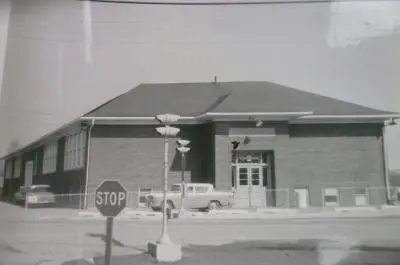
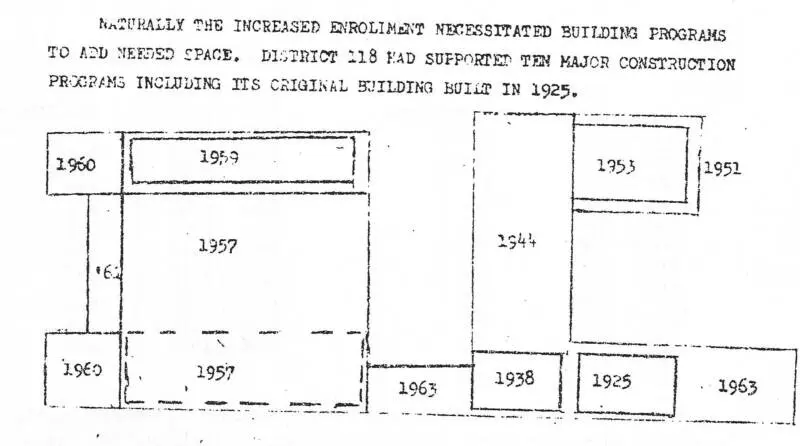
Original Woodrow Wilson razed in 1964.
Peoria Heights School, District #120
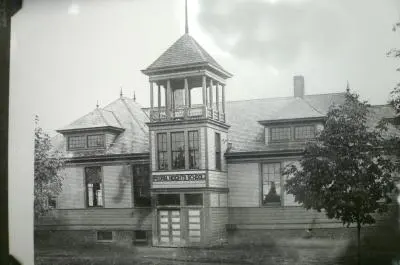
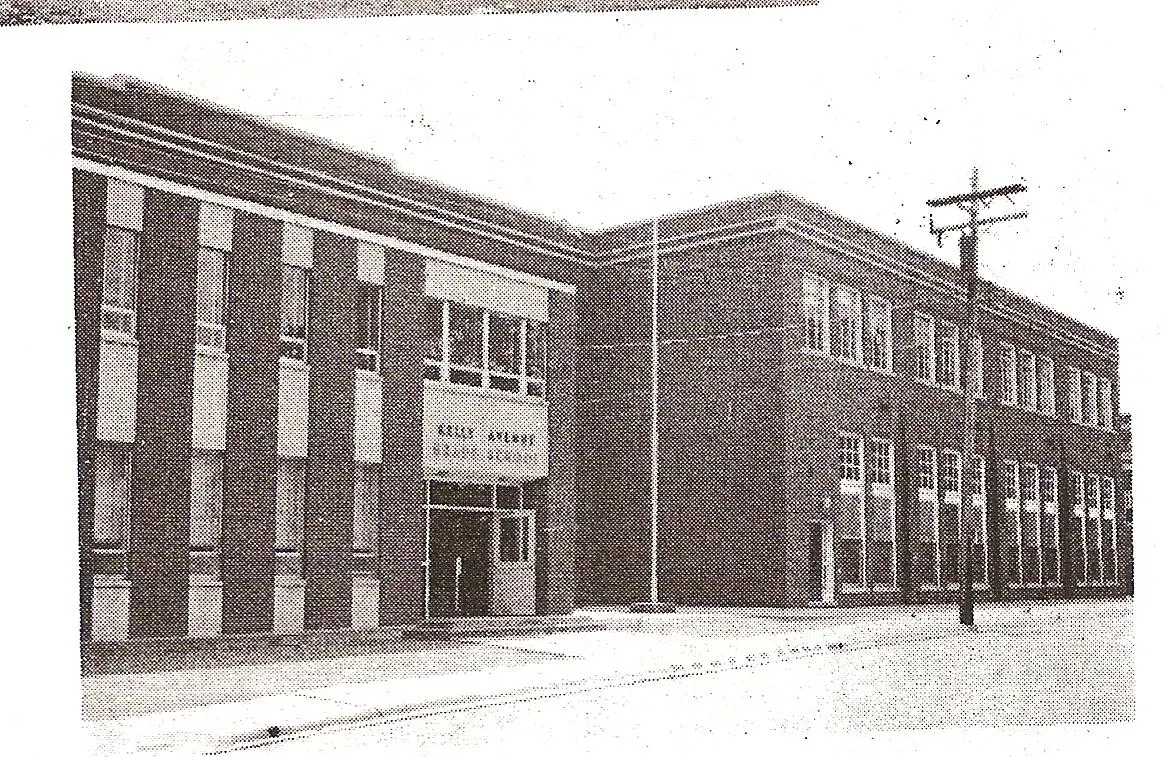
Old Peoria Heights School located at Prospect and Marietta. It later became Heights Congregational Church and still later Masonic Temple. The building was razed in 1953.
The history of the schools in Peoria Heights began back in 1877, just 12 years after the end of the Civil War. Calvin Schnebly gave a log cabin to School District No. 120 which became its first schoolhouse. The building stood on the corner of what is now Lake and Prospect, but was then called Mt. Hawley Road. It was a narrow dirt road running from the McClure entrance to Glen Oak Park to the depot at Kellar Station. The school was named the Richwoods Academy. Mr. Schnebly’s daughter Cora became the first teacher at the school. On opening day, the only books available to the students were her Holy Bible and dictionary. So the first day’s lessons were reciting the Ten Commandments. During the three years Miss Schnebly taught at Richwoods Academy, she had a total of 21 pupils.
The second school to be built in Peoria Heights was erected in 1882. It was a frame building that stood on the east side of Prospect Road, just south of the Railroad tracks, where the Clark Gas Station now stands. It was called the Munk’s School, so named for the two bachelor Munk brothers who owned and operated a gristmill nearby. The first teacher of this school was Alexander Chittick, who started that year with an enrollment of about 15 pupils. Later Miss Madge Thompson became the teacher. She lived in Peoria, and rode the streetcar to the end of the line at Reservoir and California. On days when no one came along, she walked from there to the schoolhouse. There were about 28 pupils attending this school by 1895.
In the fall of 1896, the first bell rang in a school built on the Kelly Ave. site that is still being used today. It was a one-room frame school with a bell tower, which was quite a pretentious school building for its day. As the population increased in our village the school began to grow. By 1898 when Peoria Heights was incorporated, another room was added to the school, and by 1903 increased enrollment caused the third room to be built. By then there were over 50 pupils attending the school, and Mr. Well, school principal at that time, introduced a longer school term. In 1912, Mr. Hartzel was principal and he also taught reading, spelling, and arithmetic. Miss Fannie Corney taught first and second grades; Miss Florence McCluggage, third fourth and fifth grades; Mrs. Rhinehart, sixth, seventh, and eighth grades.
An eight-room brick school was built in 1916 on the same location. It is the same building that is being used today as the Kelly Street School. The three-room frame school was moved to the back of the lot closer to Marietta St. It was purchased by the Peoria Heights Congregational Church and served as their church until they built their first brick church on the corner Kelly and Prospect where the Standard Oil station now stands. In about 1923 the frame building became the property of the Masonic Lodge, Grandview Lodge No. 1112. It was used for this purpose until 1950 when they built their present Lodge home on the corner of Prospect and Division. The building was then torn down and the school used the property for playground and parking.
Kelly Street School had eight class rooms and a basement. Mr. William J. Hartzell was principal when school first opened. In 1923, Mr. C.W. Chism was principal and also taught 8th grade.
- 7th Grade: Miss Emma Doering
- 6th: Miss Mildred Yates
- 5th: Miss Gertrude Shively
- 4th: Miss Ruth Dunlap
- 3rd: Miss Leah Easland
- 2nd: Miss Lillian Pulli
- 1st: Miss Gertrude Pauli
There were two teachers in first grade. They taught in the same room until the east wing was added 1924. At first only the lower floor of the east wing was finished and used. By the following year the upper floor was also in use. In 1927 the west wing, including the gym, was added and mid-year classes were started. On the upper floor of this wing there were “Open Window” classes on the south side. This was for treatment of inactive T.B. cases, a borderline child who was in frail health. Mrs. Ora Doebler was in charge of this program, and Miss Illa Hamm assisted her with the lower grade children. They wore flannel suits with caps and boots. Cots were put on one of the rooms for rest periods. The children were taken to the basement at first for milk, and were later served hot lunches.
In 1937 kindergarten was started. Mrs. Leinberger was the first teacher for children four years or older. By 1945 the complete building was in use. Mr. Chism served as principal until 1938 when Aman L. Ohlman took over the duties. He had come to the school in 1934 as a teacher. Mr. Ohlman served as principal until his retirement in 1965, with 31 years service to the school. In 1968 a District Unit was formed and Mr. Carl Richards was principal followed by Mr. Roger Bergia.
In 1954 another school opened in Peoria Heights. It was called the Monroe Avenue School. They became part of District #325 along with Peoria Heights High School and Kelly Avenue School.
Peoria Heights Community Unit School District #325 proposed a bond referendum on November 3, 1998. Because of the age and deteriorating condition of Kelly Avenue School, the school district applied for a free Construction Grant from the Illinois State Board of Education. The entitlement, in the amount of $2,570,661, was given to our school district on August 20, 1998. The entitlement was given because the State Board of Education (based on priorities) felt that the Kelly Avenue School needed to be replaced. With the passage of the referendum and the grant entitlement, the school district will build one new elementary school on Glen Avenue for all the elementary students in Peoria Heights School District #325.
Kelley Avenue School was demolished and a mall was built on that property.
The township that turned into city
Richwoods lay right against the city of Peoria, and its districts were drawn into city and village schools early. Reservoir Heights was taken into the city of Peoria and District #150 in 1928, according to the history above. Richwoods School, District #116, closed in 1946 and joined Wilder-Waite #303, and Wilder-Waite in turn became part of Dunlap Community Unit School District 323 when that district was formed in 1969.
The big change was the annexation vote of November 1964. Kellar, Hines, Sipp and Woodrow Wilson, together with Rolling Acres, Spartan and Northmoor, became Peoria District 150 schools in 1965. Peoria Public Schools District 150 still lists Hines, Kellar and Northmoor among its primary schools. Others carry new names. Woodrow Wilson was renamed Dr. Maude A. Sanders Primary School in 2018. Lindbergh, the old Kellar West, was later renamed Liberty Leadership Middle School, and Washington Gifted, built on the Reservoir Heights site, became Reservoir Gifted Academy in 2022. Rolling Acres is now a middle school.
On the Peoria Heights side, Peoria Heights Community Unit School District 325 was organized on March 17, 1969, from Gardener District 112, Peoria Heights District 120 and the remaining territory of Richwoods Community High School District 312. The high school building dates from 1971, and the grade school next to it from about 1999, which matches the plan for one new elementary school described in the 1998 referendum above. Kelly Avenue School was torn down for a strip mall, and Monroe Avenue School became a private middle school.
Most of old Richwoods Township now lies inside the city of Peoria, whose own township grew along with the city until 1991. What remains of Richwoods Township is mostly the village of Peoria Heights, and the 2010 census counted 6,089 people there.
Common questions
When did Richwoods Township schools join Peoria District 150?
Richwoods Township voters approved annexation to the city of Peoria in November 1964, by 336 votes according to the township history. In 1965 Kellar #111, Hines #113, Sipp #117 and Woodrow Wilson #118 became Peoria District 150 schools. The District 117 board was dissolved, and Sipp, Rolling Acres, Spartan and the new Northmoor school went into District 150 together.
What happened to Sipp School in Peoria?
Sipp School began on land Adam Sipp deeded in 1859 and grew into a large school at University and Glen, from 138 pupils in 1949 to more than 800 by 1959. District 150 closed it because of declining enrollment, and the building was demolished in 1985. A Peoria Toyota-Volvo dealership was planned for the site, and the page notes a Chili's there later.
Where was the Woodrow Wilson School in Richwoods Township?
District #118 built its first Woodrow Wilson School in 1925 on a half acre on the north side of Forrest Hill Avenue, bought from the heirs of William Finnell. Enrollment rose from 25 pupils and one teacher in 1924 to 1,094 pupils and 40 teachers in 1966. Peoria District 150 renamed the school Dr. Maude A. Sanders Primary School in 2018.
What was the first school in Peoria Heights?
In 1877 Calvin Schnebly gave a log cabin to District No. 120 at what is now Lake and Prospect. It was called the Richwoods Academy, and his daughter Cora was the first teacher, with 21 pupils over three years. The Munk's School followed in 1882, then a one-room frame school on Kelly Avenue in 1896 and the eight-room brick Kelly Street School in 1916.
Is the Gardener School building in Richwoods Township still there?
According to this page, Gardener School, District #112, closed in 1965 and its building was later bought by Tousley-Iber Co., general contractors. The upstairs classrooms became company offices and the gymnasium a warehouse. The school site was bought from William Barton for $100 in 1874, and a $75,000 addition in 1947 brought two classrooms, a kindergarten room and a gymnasium.