Schools and Consolidation 1945
- Elmore School, District #85: 1946 #305, 1969 #326
- Nightingale School, District #86: 1946 #305 Princeville, 1969 #326 Princeville CC
- French Grove School, District #87: 1946 #305, 1969 #326
- Laura School, District #88: 1946 #305, 1969 #326
- Garrison School, District #89: 1946 #305, 1969 #326
- Scotland School, District #90: 1947 #307, 1948 #309 Brimfield
- Campbell School, District #91: 1946 #305, 1969 #326
- Spring Valley School, District #92: 1947 #305, 1969 #326
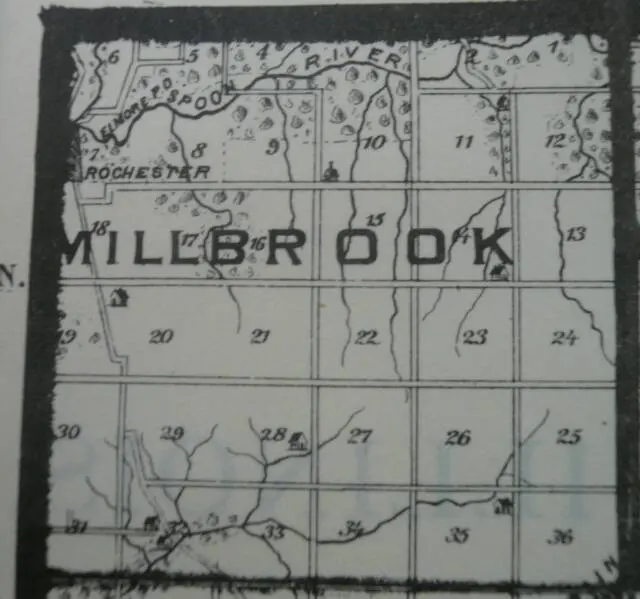
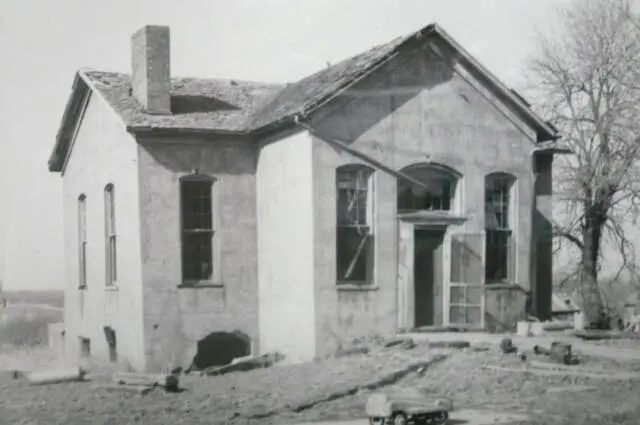
Elmore School, District #85
The village of Elmore was laid out about 1835 and soon after people from the east began to settle there. It was very shortly after this that the first school was erected. It was hewn out of logs like many of the earlier schools and located on the same site as the present building. This was quickly replaced by a frame building out by a mill which was built in Elmore very early in this small town’s history. This building is still standing but is used as a billiard hall now and has been moved from its original site.
By 1867 this building could not hold the growing crowd. A two-room brick building was erected from brick made in the Elmore brick yard. This building took two teachers and the school had about eighty pupils enrolled in it. The population of Elmore was growing very rapidly and it looked as though Elmore would be one of the large cities of Illinois. Spoon River furnished water power to operate a flour mill and a large saw mill which were erected and the lumber and flour were sold for many miles around and those coming to get these products most often planned on staying over night, so also a large livery stable and hotel were kept busy. All of this became a thing of the past in 1890 when business became so poor that all such activities were stopped.
In 1838, some women with college educations, who came from the east, started a seminary. This “College” lasted until 1860 when it was abandoned. No one who attended it is now alive and no influences can be noticed.
As a social center, Elmore or Rochester, Illinois, was noted for miles around. Attractions of various kinds drew the people from great distances. Singing, dancing, and writing schools held their way for many years and weekly debate always drew a large crowd while the spelling bees never failed to pack the large school room. At one time a Good Templars organization functioned. Also a chapter of the M. W. of A. had a large number of members. Two churches, a Christian and Methodist enjoyed large congregations. All these and many other things have changed. The churches are very nearly a thing of the past. The organizations have ceased and no longer do the social classes have any appeal to the people so now with a very much smaller population and a school of 17 pupils, Elmore goes on in its sleepy way, now only the spot where once great history was made and probably in a few more decades, unless the oncoming generations read about their home of Elmore from a history book, will they ever know that at one time this beautiful little spot was one of the potential spots of the one large city of Illinois.
The school building has not been changed a great deal since it was built in 1867. It has had modern improvements added from time to time to keep it according to state regulations and it has all the comforts necessary for a school. Each year a class is graduated which goes out into the world, some first equipping themselves with higher education and others just attempting to face their future with what Elmore has given them.
French Grove School, District #87
Mrs. Theo. Pursell and Mrs. Martha Moore of Brimfield recall that the church people first worshipped in the schoolhouse in 1852. The school grounds were a part of McCoy’s timber. The first settlers to French Grove were from Virginia.
The first schoolhouse was burned October 16, 19--. The origin of the fire was unknown. School was then held in the vacant parsonage of the French Grove Church which had been built near the schoolhouse in 1856. The present school building was erected the same winter that the old one burned.
The first teacher to teach in the new schoolhouse was Minnie Kelso, who conducted a school for twenty-three pupils.
A new well, which is 227 feet deep, was drilled during the summer of 1930. The district sold walnut logs from the schoolyard in 1926 for $50.00. The school has a good library, and funds for the books were available from school entertainments.
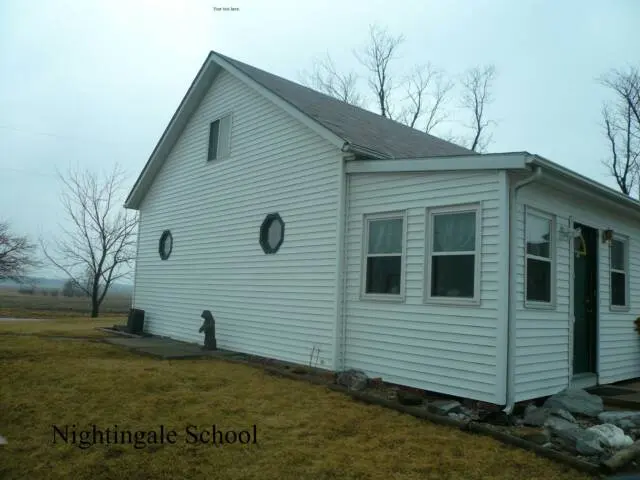
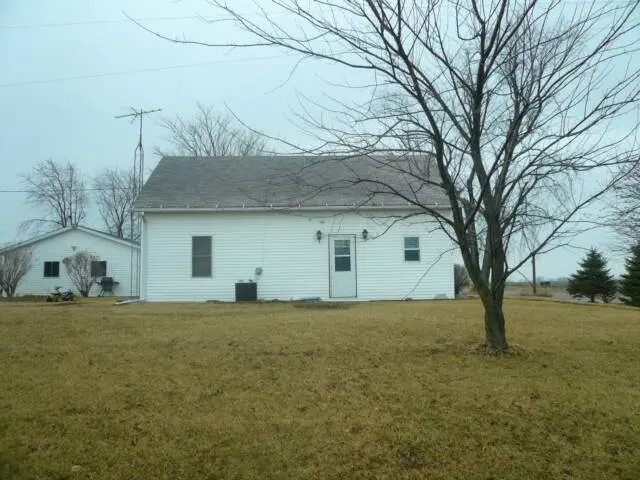
Nightingale School, District #86
The first school building in Millbrook Township was built in what is now District #86 of Peoria County and was about a quarter of a mile from the present school site. This building was erected in the year of 1836. The structure was composed with logs, and had an old-fashioned fire place with a mud dob stick chimney. The desks faced the outside walls and were placed all around the room. The master who presided in the middle was supposed to be able to keep watch over his school with this arrangement.
The first teacher was Kaleb North, who claimed descendancy from Lord North, a notable figure in early American history. He was a gentleman of the old school and conducted his little institution of learning easily and with credit. The school in its original state was under precinct organization but later came into the county list. Between 1840 and 1850 the family of Elishu Labertson moved into the neighborhood. The exact year is not certain but as they had no home upon arriving in the community, the school was donated to them until they had their home built.
In 1856 a new building was constructed on the northwest corner of the northeast quarter of section 19. The old building was sold to Mr. Nightingale who lived on the farm nearest the school and the building has since been used as a granary. The new building was a frame structure with seats on either side. The teacher’s desk was placed toward the front of the room.
The directors from time to time have had improvements added to the old building. There is a hall in the front of the building where the pupils hang their wraps. A large jacket heater in one corner takes the place of the old cannon stove which once stood in the center of the room. The lighting has been changed so that the light comes from one side and the library, dictionaries and maps have been added to, and changed as it was found necessary.
Laura School, District #88
The first school taught within the present bounds of what is now District #88 was located where the residence of Roy Whittaker now stands. The building was an old frame dwelling house and accommodated about sixty pupils. It was taught the first few terms by Miss Lizzie Kellar, who when teaching the first term in 1859, was seventeen years of age. The pupils sat on benches made by the fathers of the community and had no particular course of study to follow but learned their alphabet, attempted figures and practiced writing and spelling. Later geography was added. Reading and recitations were heard individually and the figures were worked on a slate and shown to the teacher. The teacher’s work was to maintain order and to direct effort, and she strove to stimulate the children to utilize their school days, which were few in number, to the best of their ability.
The next building, built in 1891, was a one-room frame structure, erected on what is now the C.C. Davis farm. This schoolhouse was large and used from that time until 1893.
In the year of 1893, the district to be used for furthering education erected a very fine and commodious, well-equipped one-room frame building. The school building of 1893 had some of the furniture of the old school installed in it. This has since been removed and more modern equipment installed in its place. The room was later fitted with a large furnace and a large library added. In 1910, it became necessary to build another room to accommodate the growing wants of the district. A primary room was added, a steam furnace installed, the walls tinted the proper color for a schoolroom, the lighting regulated, and modern teaching apparatus of all kinds purchased. The playgrounds are large and well equipped and cement walks have been laid to the building.
It was built of brick and had two rooms. Two teachers were employed when the number of pupils merited it. The school was large at that time as grown men and women attended, some of them for the purpose of trying the teacher out or having a good time some other manner.
The building was built on the same plan as that of the church with a belfry on top.
One night during the spring of 1904, this schoolhouse was destroyed by fire, which was started from an overheated stove, it is presumed. Miss Ollie Melville of Oak Grove was teaching the school at that time. Mr. D.T. Thorme, formerly Miss Belle Daily of Peoria, taught in this schoolhouse. Miss Susie Douglass of Seattle, Washington was also a teacher there.
This school year was finished out in the church. Before time for the opening of school in the fall, the present schoolhouse was built. This is a brick building containing two rooms. The north room was called the Hall, and was used for dances, parties, and other social gatherings.
The building was made into a two-room schoolhouse in 1928, and since then both rooms are used for classes and two teachers are employed.
Many improvements have been added from time to time. During the summer of 1930 a basement was excavated under the north room. This is used for entertainments and social gatherings.
Garrison School, District #89
The first school building in the district was an old limestone building. It was small with a very low roof. The limestone was taken from the woods not far from the building site. There are no records as to the name or district number. It is remembered as the old Stone Jail. The records and the deed to the land have all been lost or destroyed.
The Garrison School Building, District 89, is located one mile north of the original building site. The deed for the land, donated by Themeil Garrison, has been destroyed or lost with the early records. The earliest recorded date is 1870. It is thought that the present building was erected sometime between 1888 and 1889, and was named the Garrison School. Later the name was changed to Point Pleasant, Dist #5, but after a period of about fifteen or twenty years, it was changed again to Garrison. The reason for this is unknown.
The old iron rails around the schoolyard were placed there 1882. The present building is the same original structure that was erected in 1869 or 1869, not altered in any way except for repairs.
John Hayes
Lewis Campbell taught at Garrison School in about 1869.
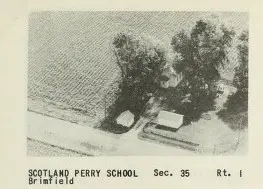
Scotland School, District #90
The Scotland School District #90 of Peoria County was erected in the year of 1858, and this building is still in use seventy-three years later. The contractor for the building was James Ullrich.
The land for miles around the school is a rich level prairie. The name, which had been fixed to this community, was Scotland Prairie and the School was named in a like manner. The Scotland School at present is located about twenty-five miles northwest of the county seat (Peoria). At the time of building, a site had been chosen about one mile north of the present site. Before any construction had started however, some of the people in the south part of the district disliking the idea of having to live so far from the school and having the same taxes to pay, insisted that a vote be taken to determine the site. There were some bad feelings in the neighborhood for a time but finally a vote was called and it was decided to change the site more near the center of the district and the building was erected on its present site. Once since then, the building was moved to make it nearer the road but it still stands on the same acre where it was built.
The school when completed consisted of a small room, which contained six windows. The room contained only that furniture which was considered strictly necessary. The walls were bare, and coarse wooden benches served for both seats and desks. The stove was a little low heater, which stood in the center of the floor and sent most of its heat up the chimney. Still the school was as good as the average of those days and much better than many.
The first five readers were taught the first number of years the school was operated. Other studies taught, in conjunction with the reading, were spelling, arithmetic, geography and language. About 1880, history and physiology were added to the curriculum, as was another year to the regular course. About this same time the old benches were removed and new double seats installed. The walls were also papered for the first time.
In 1887 the schoolhouse began to take on a more modern aspect. New furniture had been added, new books were purchased for the library and the courses began to become regulated for each class and a stipulated amount of work was required each year. The number of students had dropped off considerably and it was easier for the teacher to, in a more concentrated way, see that each student met certain qualification.
In 1898 a partition was made in the schoolhouse so as to divide it into two rooms, the new room being very small was called a hall and used for the place to hang the pupils outdoor wraps and dinner buckets.
In the winter 1902, the school building was slightly damaged by fire, which resulted from an overheated stove. The fire occurred one morning when school was in session, the teacher Miss Nora McCarty, and the pupils being the only ones present when it started. The northwest corner of the room which is near the chimney, caught on fire and it seemed probable to those present that district #90 would be likely have a new school building but James McGin, one of the nearest residents, rushed to the scene and extinguished the blaze unaided. The damage was small and quickly repaired.
In 1911 a new sanitary room furnace was put in the school room, which was a much better way of heating the room. New seats and desks were added for the smaller children and new curtains purchased for the windows.
During the winter 1913, a box supper and entertainment was given at the school, the proceeds being used to buy an organ, library books, a clock and a globe.
On March 31, 1915 the school was added to the standard list of Peoria County and the following year the interior was redecorated. The school is quite old now and getting more out of date each year. The directors have tried to improve it as best they could but with a building seventy-three years old, not much can be done. With the new lighting regulation, the school has its standard school standing.
Campbell School, District #91
Campbell School District #91 of Peoria County derives its name, like most schools, from a prominent citizen and land owner of the community.
The first school stood about twenty rods north and twenty rods west of the present site, in the center of a field. Some of the timber and parts of the old foundation can still be seen at the site. The school started about 1863 but due to the fact that there were about 60 pupils, half of whom were over 18 and some who are past 21, it was difficult to secure a teacher to handle them and it was not until 1867 when the district hired Lewis Campbell, a veteran of the Civil War at the exorbitant salary of $50.00 per month, that a successful school term occurred. Several teachers had been successfully run out of the neighborhood by this same gang of boys but when Mr. Campbell got through thrashing each and everyone of them they realized they were licked and no teacher has ever run from the school district after that.
After a few years, the fall and spring terms were taught by lady teachers, so docile had become the youngsters of the community. These teachers received $35.00 per month. Four courses were taught, reading, writing, arithmetic and spelling, and these courses were taught all three terms.
In 1869 the new schoolhouse was built. It is located three miles from the small town of Laura, three miles south of the Stark County Line, and one mile west of Princeville Township. The building is the common frame type with four windows on each side, a small entry in front with two cloak rooms on either side of the entry and a stove in the center of the room furnished the heat.
In 1917 during the summer, the school was much improved by a new coat of plaster and paint. The windows were placed on the west side to provide the pupils with light from their left sides, a better heating and ventilating system were installed, sidewalks laid and well dug. The well turned out to be of no account and drinking water still has to be carried from the nearest farmhouse.
At present the school is fairly well equipped with maps, library and reference works. The yard and grounds are large and well kept and the large trees of the yard furnish plenty of shade for the hot fall and spring days when school is in session.
Spring Valley School, District #92
The Spring Valley School, #92 of Peoria County, which is located about 5 miles northwest of Monica, was built about 1857 or 1858, the exact record having been lost. The land was donated with the condition that should the school ever be discontinued or moved that the land would go back to the estate. When the school was built, deer, a great number of prairie chickens, inhabited the country, rattle snakes, wolves and a few people.
Calvin Pryor was an early settler in the community and an active and intelligent worker for educational institutions. The first schoolhouse was very similar to most of the other schools of its time, being a frame building with benches serving for seats and desks and a cannon stove in the center of room, used for heating purposes. The first teacher, who taught, started in a winter term, which lasted for three months. The school in its early days had three terms, the fall term, the winter term and the spring term. Of the three terms, the winter term was attended the best because the older pupils in the community were able to get excused from work on the farm during that period of the year. Shortly after the Civil War, a man by the name of W. T. Whiting, taught the school. He was a man much interested in politics and spent as much time trying to convince the people of the community to his belief, politically as he did in teaching the school. He was a great believer in the greenback theory, which had been brought out at that time. This caused a lot of concern among many people of that time. The government had issued considerable paper money for which they had promised to pay the holders in specie after the war. At the end of the war the government was in no financial position to do this and the believers in the greenback theory attempted to convince the people that the paper money was as good as the gold or silver. They had little success however until about ten years after the war when the Secretary of the Treasury issued a statement that he would redeem all the paper money with gold and silver. Upon getting this word the people did not go to the trouble to have it redeemed but started using it as legal tender. Mr. Whiting later became a well-known figure in a political way and community was glad that at one time he had taught their school.
John Hayes
Where the Millbrook children went
The 1945 table above tells most of the story in two steps. Seven of the eight Millbrook districts, Elmore, Nightingale, French Grove, Laura, Garrison, Campbell and Spring Valley, were folded into consolidated district #305 in 1946 and 1947. In 1969 that district became part of #326, the Princeville unit district. Scotland School, District #90, went the other way: into #307 in 1947 and then into Brimfield's #309 in 1948.
Both of those unit districts are still operating. Princeville Community Unit School District 326 runs Princeville Grade School and Princeville Junior/Senior High School in the village of Princeville, in the township next door to the east. Brimfield Community Unit School District 309 keeps its grade school and high school across the street from each other in Brimfield. A child growing up on a Millbrook farm today rides a bus to one of those two towns rather than walking a mile to the schoolhouse at the crossroads.
The villages the schools served have mostly thinned out, much as the Elmore writer predicted in the 1930s. Laura was platted in the late 1880s and named for the daughter of a railroad official, and a post office called Laura has operated there since 1888. Elmore, the old Rochester on the Spoon River, never became the large city its mill owners expected, and its school had dropped to 17 pupils by the time John Hayes gathered these histories.
At least one building from the list was still standing when this site was compiled. The photographs above show Nightingale School, District #86, at Nightingale Road and Elmore Road in 2009. If you know what became of the Laura brick schoolhouse, the Scotland building of 1858 or any of the others, county researchers would be glad to hear it, and the Peoria Public Library's local history collections are a good place to leave that information.
Common questions
What one-room schools were in Millbrook Township, Peoria County?
The 1945 list names eight: Elmore #85, Nightingale #86, French Grove #87, Laura #88, Garrison #89, Scotland #90, Campbell #91 and Spring Valley #92. Each district had its own board and building, and several were older than the township itself. Nightingale claims the first school in the township, a log building put up in 1836.
When did Millbrook Township schools consolidate?
Most of them joined consolidated district #305 in 1946, with Spring Valley following in 1947. In 1969 that territory became part of #326, the Princeville unit district. Scotland School took a different path, joining #307 in 1947 and Brimfield's #309 in 1948, so its pupils ended up in the Brimfield schools.
Which school district serves Millbrook Township today?
Most of the township falls to Princeville Community Unit School District 326, which runs Princeville Grade School and Princeville Junior/Senior High School. The old Scotland district went to Brimfield Community Unit School District 309. Families should check their exact address with either district, since the 1940s lines still shape the boundary.
Is the Nightingale School building still standing?
It was in 2009, when the photographs on this page were taken at the corner of Nightingale Road and Elmore Road. The district's first log school of 1836 had been sold to Mr. Nightingale and used as a granary, and the frame building of 1856 replaced it on section 19.
Who was Lewis Campbell?
Lewis Campbell was a Civil War veteran hired by Campbell School, District #91, in 1867 at $50.00 a month. Earlier teachers had been run off by a gang of older boys, some past 21. He thrashed every one of them, and the district had no more trouble keeping a teacher. He also taught at Garrison School about 1869.