Radnor Township Schools 1945 Consolidation
- Keady School, District #102: 1945 #105 Dunlap, #302 Dunlap; 1969 #323 Dunlap
- Bell School, District #103: 1945 #302; 1969 #323
- Salem School, District #104: 1946 #302; 1969 #323
- Dunlap School, District #105: 1945 #302; 1969 #323
- Glendale School, District #106: 1946 #303 Wilder-Waite; 1969 #323
- Tucker School, District #107: 1946 #303; 1969 #323
- Hazel Dell School, District #108: 1945 #302; 1969 #323
- Parks School, District #109: 1945 part #8 Summit; 1954 part #302; 1945 part #105; 1945 part #302; 1969 #323
- Dewey School, District #110: 1946 #303; 1969 #323
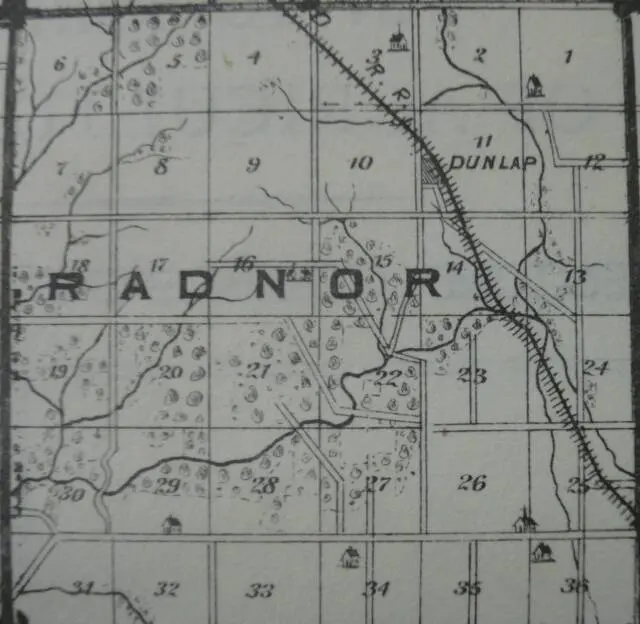
Keady
No information on Keady School
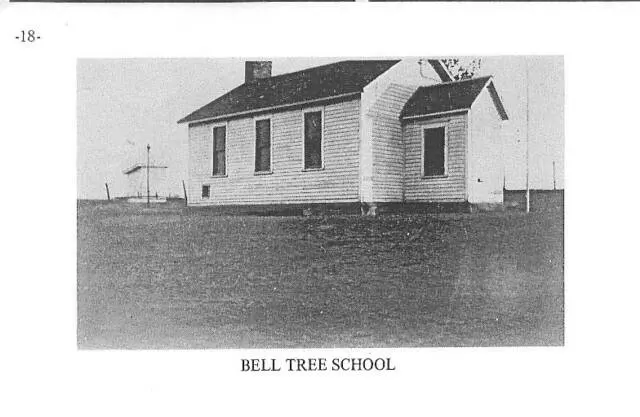
Bell Tree School, District #103
Bell Tree School District #103, was an outgrowth of an enlarged district, which separated in two parts. Hazel Dell keeping the original location and Bell Tree being built about one mile north of the old site. The first building of the original school was built about 1865. It was constructed of brick and was not large enough to take care of all the children in the district, so instead of enlarging this building, the people thought it more practical to divide the district, thus making the distance which the children had to walk to school much shorter.
The first school building known as Bell Tree is the one and only building which has stood since its erection. The name of the district was derived from a large bell, which was hung in a tree in the schoolyard when the district was started. This bell hung in the tree for many years and was rung by the teacher to call the flock in and by the pupils who wished to be annoying, etc. One day a pupil who was more than ordinarily mischievous, gave the bell a pull and it fell from the tree narrowly missing him. The bell was then put on the school building but the name of the school still remains.
Sunday School was held in the school for a number of years in the early times but no other social gathering took place. In 1924 and also in 1918, the men of the district formed a baseball team and played teams from other places.
From time to time improvements have been made such as in 1921, a large new heater was put in; in 1925 a well was dug where the children now can get their drinking water; at other times a new floor, a fire door and cement steps were added.
John Hayes
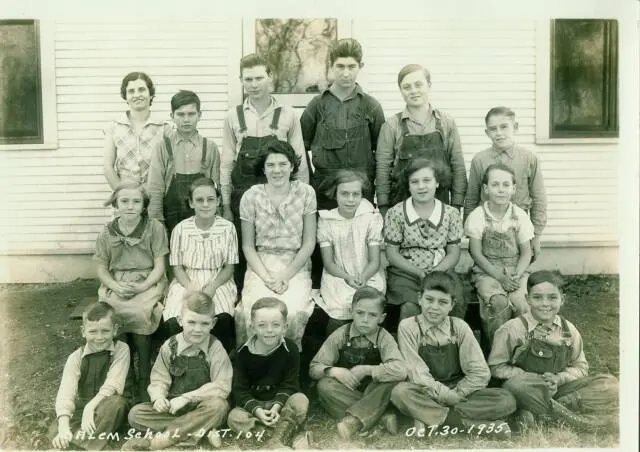
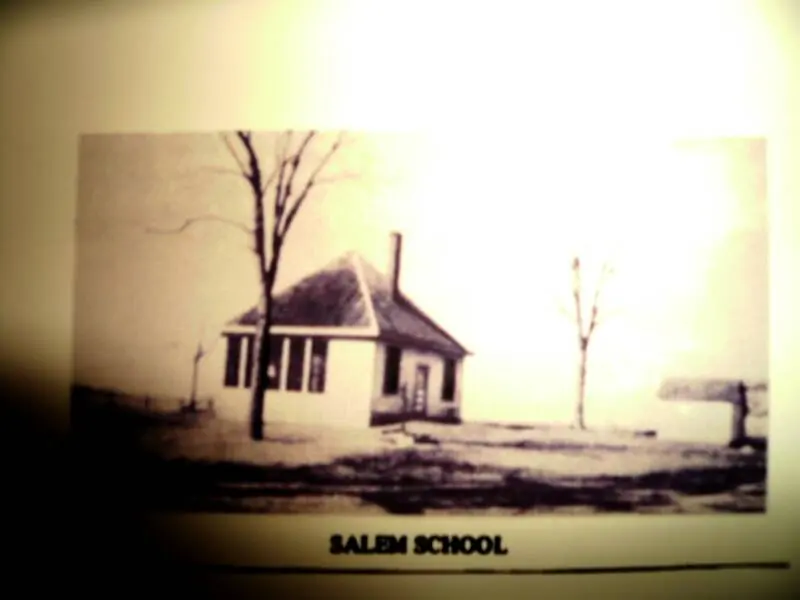
Salem School, District #104
Salem School of Radnor Township Range 7, east of the 4th principal meridian, in Peoria County was erected a year or so prior to 1850. It was poorly constructed of brick, with plank seats and desks and too cold most of the winter to hold school in but as everyone was more or less used to hardships in those days, the pupils probably had less sickness in that dilapidated old building than in our most modern equipped buildings with proper regulation of all kinds. This building was in use until 1868.
In 1865 a large Methodist Church was erected on a plot of ground in Radnor Township. The ground was ample in size to hold the building so in 1868, because the old building was becoming more and more inadequate each year, the school board arranged for the erection of a new building. The church yard being very well located was decided upon as the right spot for the school and a frame structure was erected. The school was quite modern at that time and was changed from time to time to become more so as the state regulated, and finally in 1913 after the old building had burned a building was built to conform in every way with standard school specifications.
The new school has a modern heating plant, a large library with all necessary books for reference work, separated cloak rooms, and a very nice play ground which had considerable equipment.
John Hayes
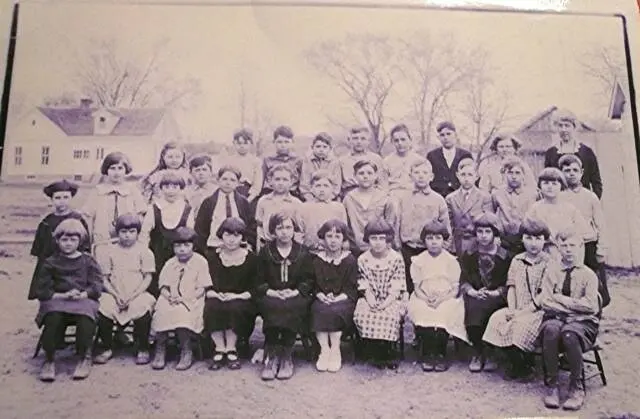
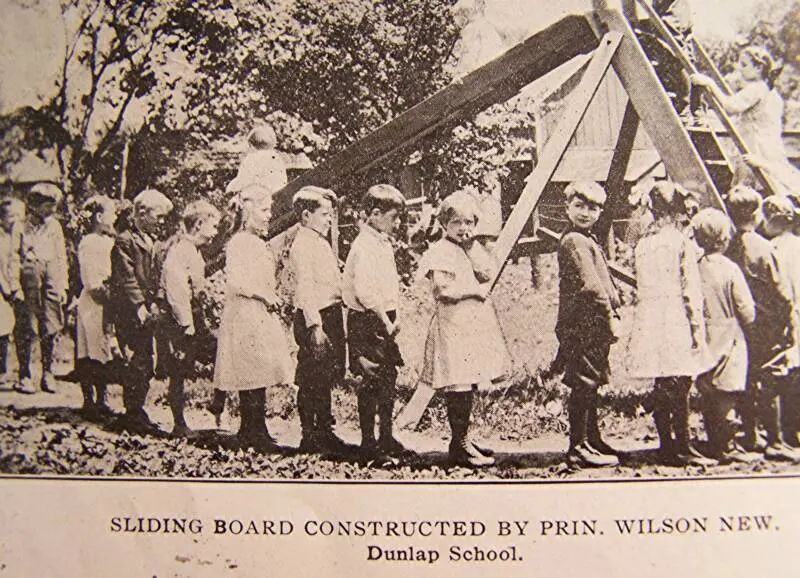
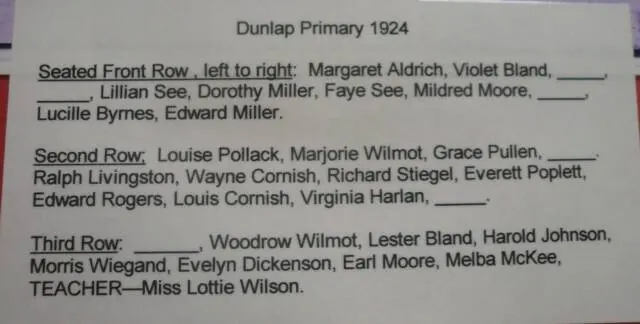
Dunlap School, District #105
The records regarding the school history of Radnor Township date back to 1840. In that year the only school for many miles around was held in a frame house erected by Mr. McClearey on his claim in the Northwest quarter of Section 13. This was before there was any organization so it was supported by subscription. Miss Ellen Dunlap, the first teacher, received $24.00 for three months work and “boarded around”. There was not a road but the way was made easier as there were no fences to obstruct the short cuts. The next summer, Miss Dunlap taught in a log house in the same section. Forty-three pupils were enrolled for that term.
The first attempt to organize a school system in this district was in 1841. In those days an attempt to locate a school as near the center of the population as possible, was adhered to. Section 13 and Section 22 were next to Section 13 and the three sections ordinarily would have gone together and had one building but the members each thought they should have the building near them so the final outcome was three buildings. These were built in 1842. One was a frame building on the southeast quarter Section 2, by voluntary labor. It was made of lumber sawed at the mill of Robert Bettes and William Brusie on the creek in Section 34.
The first district School was built for the Benton precinct, as Radnor and Kickapoo Townships were then called, in 1852, by Alva Dunlap. It was on the hill across from the place now occupied by A. Lott. The first attempt to sustain free school by taxation was in 1855.
When the town of Dunlap was surveyed in 1871, the schoolhouse last mentioned was moved to the three-cornered piece of land just south of town, and west of the R.R. track. As the town grew, in 1877, a larger building was erected in town, and very shortly another room was added but the district did not own this. Alva Dunlap built the building and rented it to the school board.
In 1899 those two buildings were moved and another building, much larger and more modern, erected. The building is a frame structure and the top floor was used for the high school. The first high school was started in 1893 and consisted of a two year course with very little choice of subjects. After the new building was erected, the four year course was started and the school has since been accredited.
In 1926, a large community high school building was erected, thus taking all of the older students from the grade building and making much more room. The new building is very fine and it is a landmark, of which the people of Dunlap can well be proud.
John Hayes
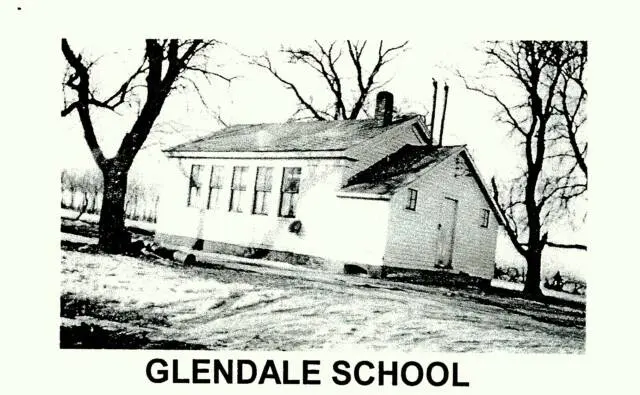
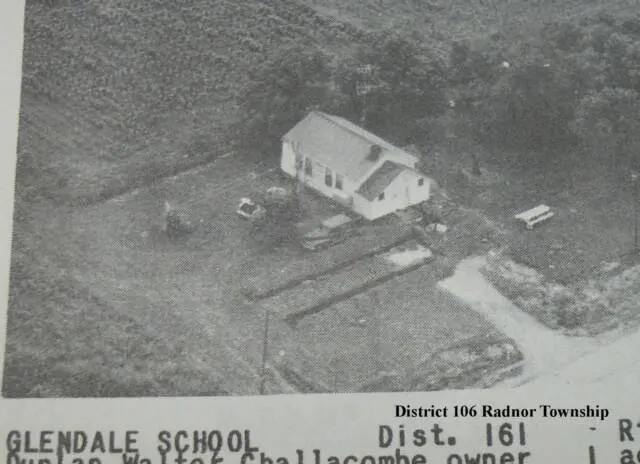
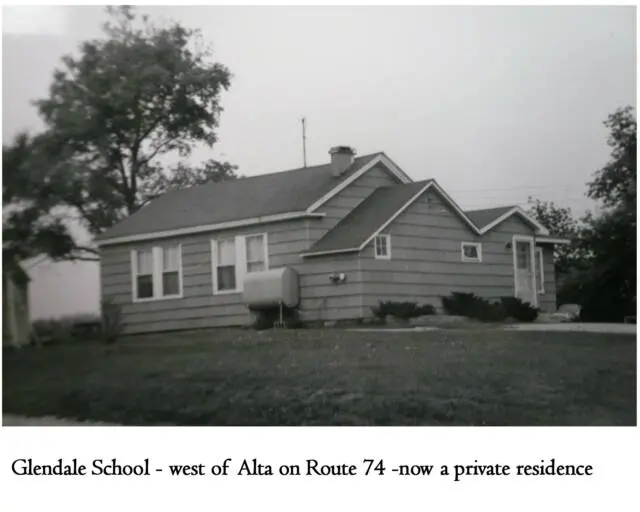
Glendale School, District #106
The Glendale School though not known in the beginning by that name, was opened in the fall of 1849 in a little log cabin. Orville Huggins was the first teacher and pupils of all ages attended. A huge fireplace that was kept filled with great logs heated the cabin.
One evening in the week a spelling bee was held, attended by all the neighborhood families. The spelling bees were continued in the new schoolhouse, which was built the next year, 1850, and is still in use.
The first winter in the old cabin, the teacher’s salary was made up by the families of the children attending the school, but a district appropriation was obtained for the building of the new schoolhouse and the teacher’s salary was paid in that way from then on.
On April 3rd, 1850, Enoch Huggins and wife deeded a piece of ground eight rod square in the N. W. corner N.W. Quarter of Section 36, Radnor Township, to School District No. 5. A short time thereafter, a schoolhouse was built which has always been known as Glendale.
After the new schoolhouse was built the church services were held here, having up to that time, been conducted in various homes in the neighborhood. Two circuit rider Methodist preachers alternated in giving the sermon each Sunday and some stirring revivals were held. In 1859 a Methodist church was built across the road from the school, and named Glendale Methodist Church at the insistence of the builder.
Ade Shaw, daughter of Harry Marie Shaw, began to school before she was three years old. She proudly told her age every day saying “I will be three years old in October.” She recited with the “infant” class, learned her letters, and took a nap on the floor every afternoon.
All the drinking water for the school was brought from the well of “Aunt Belle Livingston” who lived near by. It was a privilege to be allowed to “pass the water bucket”, and everyone drank out of the same big tin dipper. In warm weather, the whole school would adjourn to the well at noon and recess, to draw water themselves with a bucket and windlass.
Quill pens were the ones in use at that time, and it was the teacher’s duty to prepare them for the pupils. They soon played out and had to be skillfully made. This was no small task.
There were children in the school from the Huggins, Livingston, Nation, Doyle, Divelbis, Campbell, Shaw, and Gale families.
It was the custom in those times to have a man teacher for winter term and a woman for the summer.
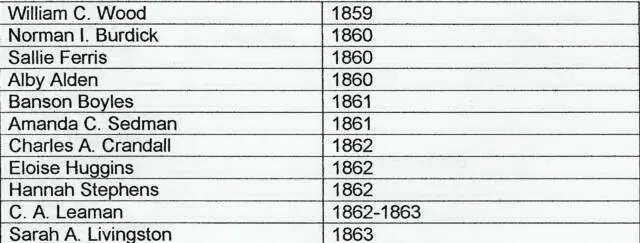
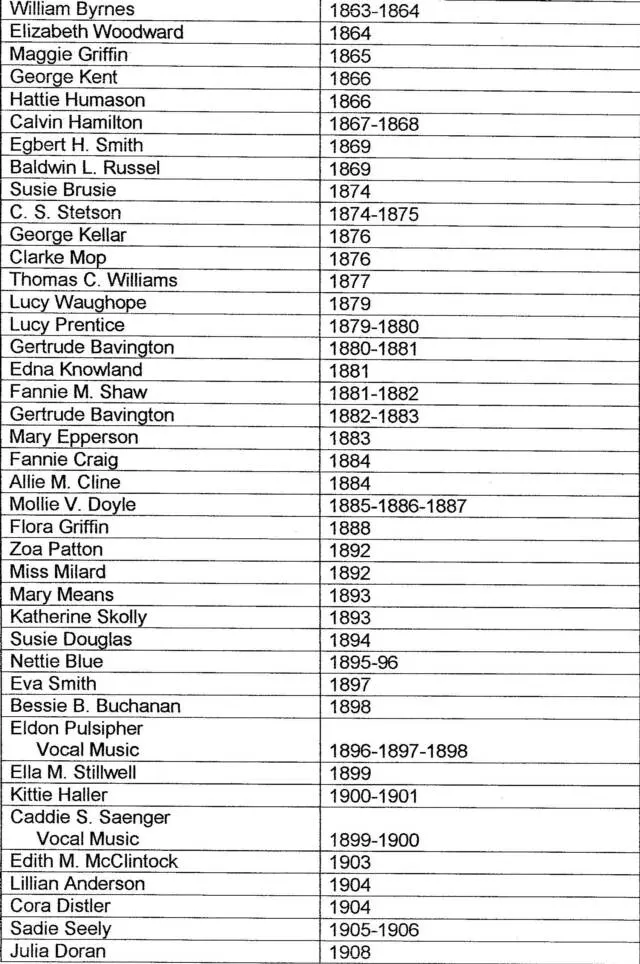
In addition to the spelling bees, the main social activities were singing school and literary societies as called in those days. A.A. Bennett taught a class in penmanship in 1879. Eldon Pulsipher taught vocal music in the years 1896, 1897, and 1898. In 1899 and 1900 Caddie S. Saenger was secured as vocal music teacher.
Mrs. Margaret Ferris, Los Angeles, California is the only survivor of the scholars who went to school in the log cabin.
The greatest number of children enrolled in Glendale School was in 1864 when Elizabeth Woodward taught. There were twenty-five boys and thirty girls making a total of fifty-five, with an average daily attendance of thirty.
The trees in the schoolyard were planted while Zoa Patton taught at Glendale.
The hard road, Route 174, was built past the school in 1928.
On Arbor Day, 1931, the pupils of the school set out a spirea.
Early teachers were Huggins, Louise Keetch, Will A. Ferris, and Mr. Marrel.
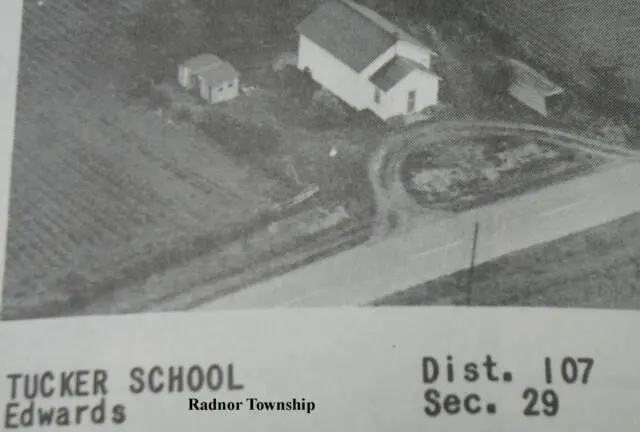
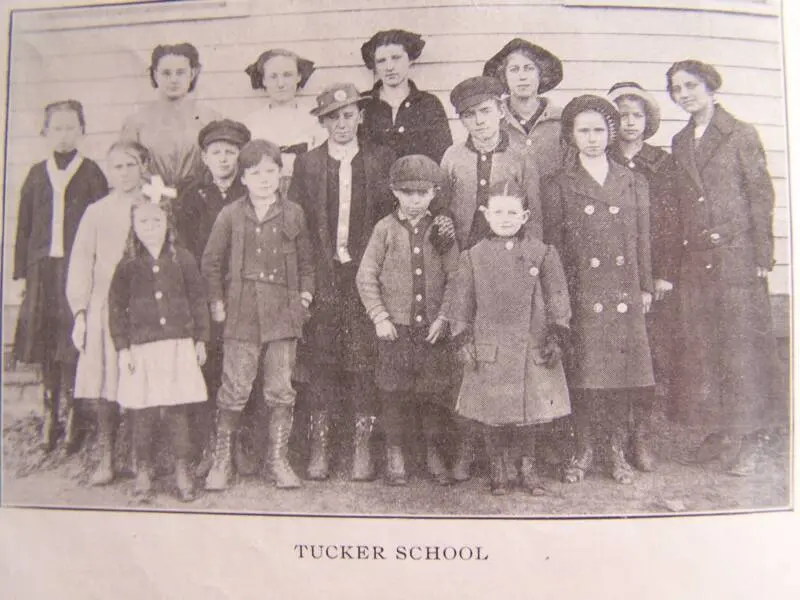
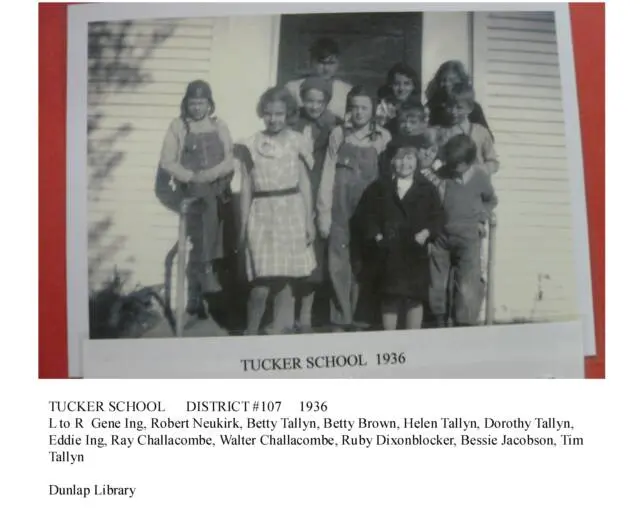
Tucker School, District Number 107
The actual history of Tucker District Number 107 started in 1855 when a low ceiling frame structure was built on the land of Cyrus Tucker, whence the name was derived.
The pupils of a school age were taught to an extent previous to 1855 as far back as 1840 at least when Mill Dunlap taught a school in section 13. In 1841, the school section was laid off into 40 acre plots and sold for $1.25 per acre, then immediately after the tax law passed, a ten-cent tax was levied in this district.
The pioneer school differed in many ways from the modern one-room school of today. It had no cloakroom or vestibule, the outside door opening directly into the schoolroom. A long bench was placed along both sides of the room against the wall. The desks, about five or six on a side, were placed at intervals in front of the bench, forcing the pupils to face the light from the opposite windows. The boys occupied one side and girls the other. A blackboard lined one end of the room, in front of which stood the teacher’s desk. A cannon stove stood in the center of the room and a long stovepipe led to one on which the children hung their clothes. The dinner buckets were placed under the benches where they were closely guarded by their owners and closely watched also by the teacher so that owners didn’t get hungry during the school period.
The first teacher received a salary of $12.00 per month for a term of months and boarded around the families of the neighborhood. The next year her salary was raised to $16.00 per month.
The district united with District Number Nine in 1858. The school had about 50 pupils.
On the fourth of February 1873, the schoolhouse caught fire and burned to the ground, with an estimated loss of about $200.00 to the district. In August of the same year, a new building was erected at a cost of $900.00. This schoolhouse, with certain alterations and improvements is in use at the present time. A cloakroom has been built on one end. The windows have been all placed on one side so as to conform to the sanitation law. The seats and desks have been arranged so as to face the teacher’s desk in the front of the room, and a modern jacketed heater has replaced the old cannon stove.
In the earlier days, the school had a large attendance. The district is a rich farming community and most of the farmers own their own farms. The children in most of the families have passed the school age and as there are very few younger married couples in the community, the attendance is small.
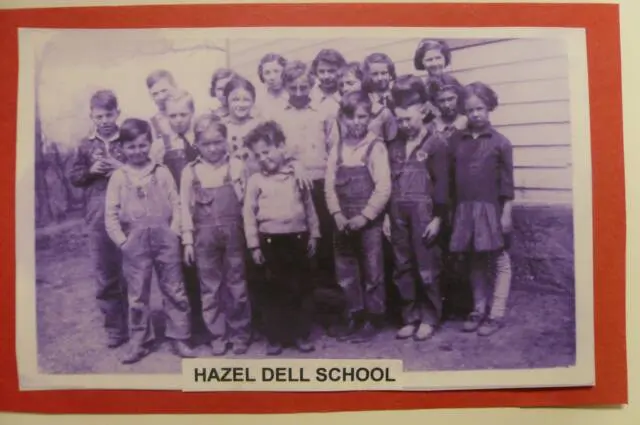
Picture from 1937 or 1938. Griff Jones and his sister and brother. Teacher Helen Black, from Stark County, who roomed with the Harlans just a short distance from the school.
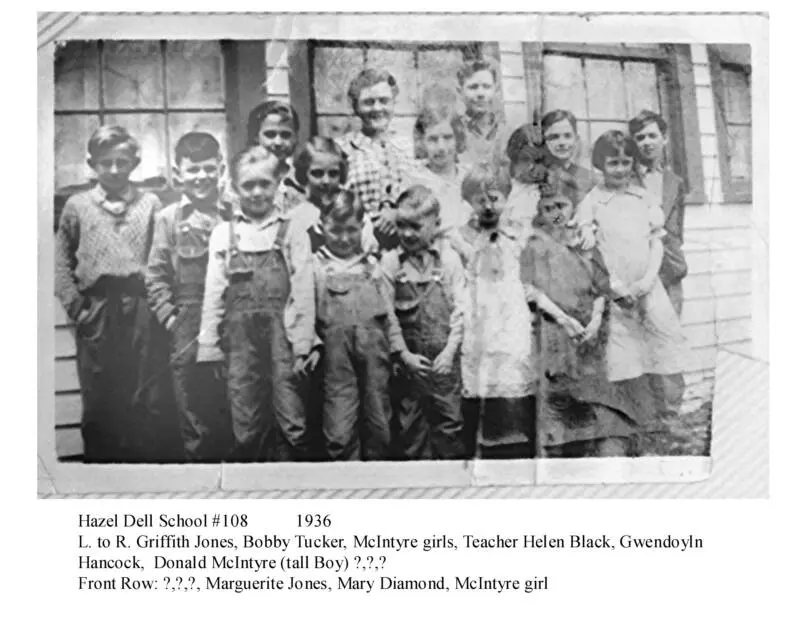
Some school memories from Griffith Jones, former student, now living in California.
I remember Gwendolyn Hancock had a brother attending but can't identify him. Also believe there was another McIntyre boy but ??? The girl behind my sister and Mary Diamond may have been another McIntyre girl. I can't be sure.
I remember Bobby Tucker because he was my best friend, and Mary Diamond because she was my sister's best friend.
Also, I considered all the McIntyre girls so pretty and with such nice personalities that, at the time, I thought they didn't belong in this one room school with us peasants. I had them all on a pedestal. I believe one was Irene and another Ileen. Can't be sure.
Gwendolyn was compassionate and friendly, but I was not close to her because we all took turns being the personal hygiene inspector and when it was her week to inspect she was too strict. Any little speck under ones fingernails was a demerit, and I often thought it unfair. I probably had my share of demerits like the other boys. Also, during her week we all had to keep our hair combed. Too funny now.
I think Miss Black, with her understanding and compassion, was the teacher that had the most influence on my life. I had her two or three years and I thought of her often but never had the chance to tell her after we moved.
This is the year I was awarded a certificate from the state of Illinois for 100 perfect spelling lessons in a row.
Hazel Dell School, District #108
The first school in Radnor Township was built for that purpose, was made of brick, and erected about 1850. Previous to that time school had been kept in a log cabin which was originally built as a home. Before any specific building was set aside however, school was taught by teachers in the several homes of families having children of a school age. The first teacher known in the township was Miss Twitchell who was closely followed by Miss Phoebe Cline, who taught in a small log cabin on the Hatfield place in the southeast corner of Section 118. After the townships were divided and the brick building erected, sections 17, 18, 19, and 20 were included in the Hazel Dell District. At first the children of the Bell Tree District came to this school but a disagreement arose and the districts were separated.
In the year of 1863, a frame building was started and by January of the following year, it was completed and Miss Ferguson was hired to teach the balance of the year. Her pay was $25.00 per month. The desks in the building were long benches made artistically by broad axes, the only tools available at that time. The school building was used for many years as a social gathering place, where the people of the community held their box suppers, spelling bees, singing schools, etc.
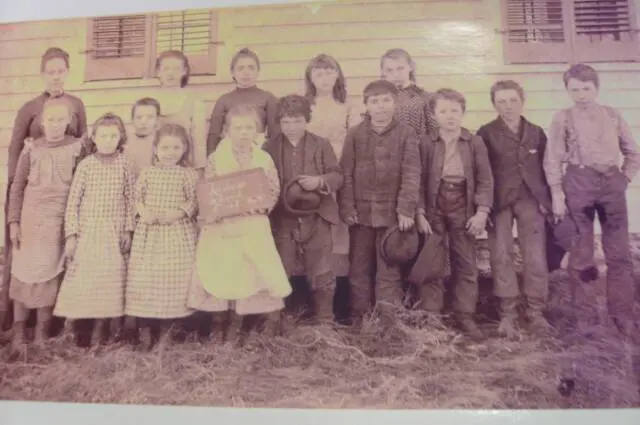
Parks School 1886, Radnor School District #8
- Back Row: Cora Camp, Maggie Pollock, Annie Houston, Lue Parks
- Front Row: Lizzie Murphy, Nettie Pollock, Girtie Pollock, Laura Pollock, Sadie Potts, Jim Murphy, Alex Potts, Art Parks, Fred Houston, Will Parks
Parks School, District #109
Parks School, originally known as the Dunlap School, is located in what was formerly known as Benton Township but later changed to Radnor. It originally comprised sections 3, 4, 9, and 10 of said township, number 10 north, range 7 east of the fourth Principal Meridian. The school building is located on the southwest quarter of section 3 on land donated by Napoleon Dunlap for school purposes in the year of 1848. There is no record which shows the exact date when the first building was erected. In 1875 the schoolhouse was sold to a family living in the district by the name of Houston. A new building (which is now standing) was built in 1875 on the same stone foundation.
The school was formerly called after the donor of the land, Mr. Dunlap, but after the village of Dunlap was born and had assumed swaddling clothes, a school was started there. In order to avoid confusion of duplicate names, the name was changed by common consent to Parks, the name of a prominent family recently moved into the district, and like a successful vaccination it seems to have “took”, and is so known at present.
So far as the present generation is aware, the institution never had any financial endowment, but had Sunday professors who exuded wisdom at every pore and held Sunday School every Sunday.
The curriculum while not as comprehensive and varied as that of our modern institutions of education, nevertheless, laid the foundations for useful citizenship with such “mental …
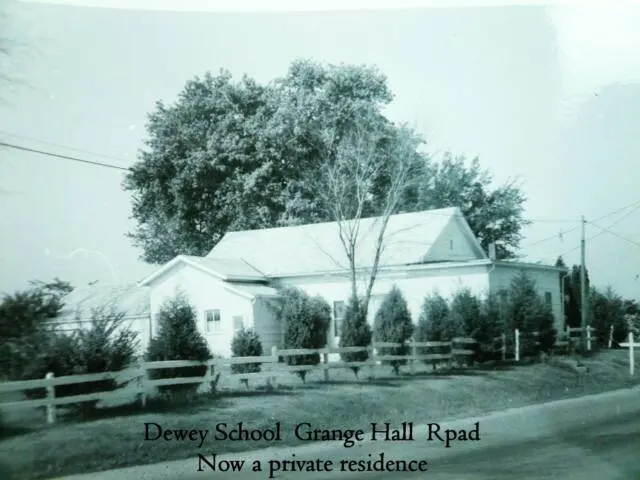
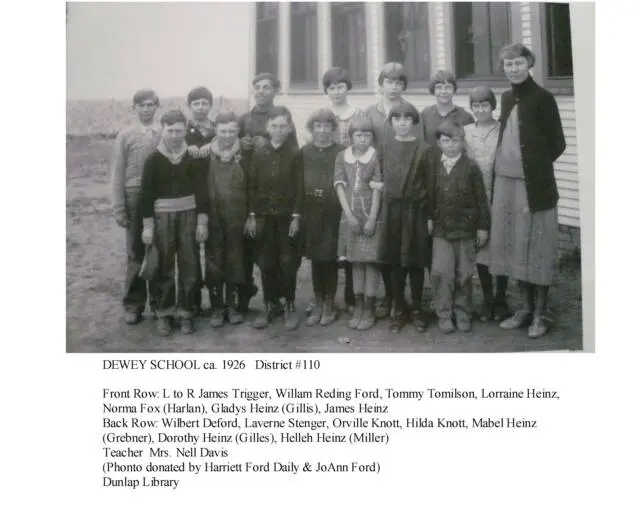
Dewey School, District Number 110
The first Schoolhouse in District #110 or as it was known until 1903, District 9 was located on section 34 and was built in the year of 1856. Charles Mayo was elected first moderator of the school and Joseph Mayo Jr. was selected first secretary. The judges of the election were Peter Sheen, James Lang, and William Dickenson. Joseph Mayo, William Dickenson, and James Lang were the first directors.
The school is located in the midst of a fertile farming district, which was settled by a number of Englishpersons. The first school was named the British Institute by the surrounding districts because of the English settlement, a name that stuck by it for many years. The first session of school was taught in the fall of 1856 by Loveady L. Woodward who had a salary of $4.50 per week and “boarded around.” She also taught the British School in 1859. This time she was paid $20.00 a month and had to board herself. In 1858 Amos Edwards taught school for $65.00 and had his board paid. John Ellis taught school here for $60.00 a month and had to pay his board. Edward Auten, residing at Princeville, was one of the teachers who had spent most of their lives around here. He taught the British School and was paid $30.00 a month.
In 1856 teachers were paid by the week and hired for a period of 8 or 12 weeks. In the year 1860, this system was changed so that the teacher was hired for a period of three months and there were three terms a year. This was superseded in 1877 by a term of six months each year and this idea was in vogue until 1885 when the 8 month school year was adopted and has been in use ever since. Fifty-six teachers have taught in this district.
In 1867, directors had a meeting to discuss plans for a new schoolhouse. They finally decided to spend $10.00 and repair the old building. The schoolhouse was a frame building, with benches long enough to seat about four pupils each, in front of which separate desks were placed. An old-fashioned cannon stove heated the room, and there was no vestibule or cloakroom.
In 1874 a new well was dug which cost $12.75. Two years later the school received new seats. Miss Purple taught that year. She later went as a missionary to China, and while returning to the United States she took sick on board the ship and died. She was buried at sea.
In 1898, a new schoolhouse was finished. It was built east of the old school. The new building was 21 by 34 and cost $517.15. The old schoolhouse was sold to E. Garland for $5.00.
The dedication took place in the fall with a former student, Dan R. Sheen, making the principal speech of the evening. At this time the school was named Dewey, in honor of the Spanish American War General.
The same building is in use, having undergone many improvements from time to time. A new sanitary heater has been installed in 1917, to comply with the sanitation law, the windows were rearranged and a new cloakroom built on the North. At this time a new large chimney was also erected. The school had a large library and sufficient reference books to take care of its needs. The playground is equipped with regulation equipment. While the enrollment is much smaller than it was back a number of years, the people in the community take a great interest in the welfare of the school and support it in a wholehearted manner.
The Radnor schools today
Radnor's nine country districts went two directions after the war. Keady, Bell Tree, Salem, Dunlap #105 and Hazel Dell were merged into Dunlap Consolidated Grade School District 302, and part of the old Parks district followed. Glendale, Tucker and Dewey went in 1946 into Wilder-Waite Consolidated Grade School District 303. The new Wilder-Waite school opened in the autumn of 1948, and Glendale was one of the schools kept open while it was being built. Alta School burned in 1945, and its pupils finished that year elsewhere.
High school work in Dunlap goes back to 1893, the two-year course described in the Dunlap School history above. The 1926 community high school had its own district, Dunlap Township High School District 158. In 1969 District 158, District 302 and District 303 were joined to form Dunlap Community Unit School District 323. The present Dunlap High School building dates from 1976.
District 323 covers all of Radnor Township, along with northeastern Kickapoo Township, the western third of Medina Township and parts of Akron, Hallock and Richwoods townships. It serves Dunlap and Princeville, Edelstein, Edwards and the northern edge of Peoria. Its eight schools are Dunlap High School, Dunlap Middle School, Dunlap Valley Middle School, and the Dunlap Grade School, Banner, Ridgeview, Wilder-Waite and Hickory Grove elementary schools. Enrollment was 4,565 in 2017.
The Wilder-Waite name still hangs on a grade school, eighty years after the 1946 consolidation that created it. Radnor Township itself had 3,613 residents at the 2010 census, on 36.95 square miles of land, a long way from the forty-three pupils Ellen Dunlap enrolled one summer in a log house on Section 13.
Common questions
How did the Bell Tree School in Radnor Township get its name?
Bell Tree School, District #103, took its name from a large bell hung in a tree in the schoolyard when the district started. The teacher rang it to call pupils in. One day a mischievous pupil pulled it and the bell fell, narrowly missing him, so it was moved onto the building. The school stood about a mile north of the old Hazel Dell site.
When did the Radnor Township one-room schools consolidate?
Most consolidated in 1945 and 1946. Keady, Bell, Salem, Dunlap and Hazel Dell went into Dunlap District #302, while Glendale, Tucker and Dewey joined Wilder-Waite District #303 in 1946. Parks was divided among Summit, Dunlap and #302. In 1969 all of them became part of Dunlap Community Unit School District 323.
Who was the first teacher in the Dunlap area of Radnor Township?
The Dunlap School history says that in 1840 Miss Ellen Dunlap taught the only school for miles around, in a frame house Mr. McClearey built in the northwest quarter of Section 13. It was a subscription school, and she earned $24.00 for three months and boarded around. The next summer she taught 43 pupils in a log house.
Why was the Dewey School in Radnor Township once called the British Institute?
District #110, known as District 9 until 1903, sat in a farming neighborhood settled by English families, so surrounding districts called its first school, built in 1856 on section 34, the British Institute. A new schoolhouse costing $517.15 was finished in 1898 and named Dewey at its dedication, after the Spanish American War hero.
Which school district serves Radnor Township today?
All of Radnor Township lies in Dunlap Community Unit School District 323, formed in 1969 from Dunlap Township High School District 158, Dunlap Consolidated District 302 and Wilder-Waite Consolidated District 303. It runs eight schools, including Dunlap High School, whose current building dates from 1976, and Wilder-Waite Grade School.